
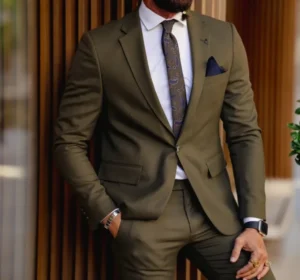
Last updated: September 1, 2026
Quick answer: For most people living and working in Dubai or Abu Dhabi, a 260–280g tropical or high-twist wool is the safest all-round choice. Drop to 220–240g if you’ll spend real time outdoors an outdoor wedding, a walking commute, a client who runs hot. Move up to 300–320g only if you’re mostly indoors under strong air conditioning or travelling regularly to cooler climates.
Ask any tailor in this city what the first question is at a fitting, and it’s rarely about colour or lapel width. It’s whether the suit will make the client sweat. Someone stands in front of the mirror, runs a hand across a swatch, and asks whether the lighter cloth will look thin, or whether the heavier one will survive the walk from the car park. Both worries are reasonable, and both come from the same misunderstanding about what fabric weight actually controls.
Fabric weight, measured in grams per square metre or GSM, tells you how much cloth you’re wearing. It doesn’t, by itself, tell you how hot you’ll feel, how the jacket will drape on your frame, or how long it will hold up under five days a week of wear. Weave, yarn twist, the canvas underneath, the lining, and the cut all sit alongside weight in that decision and in a climate that swings between a 42°C car park and an over-cooled boardroom inside the same hour, getting that balance right matters more here than almost anywhere else we’ve cut cloth.
This is the breakdown we actually give clients at The White Stripes: how 240g, 280g and 320g wool behave in the UAE, where each one earns its place in a working wardrobe, and where we see people get the choice wrong most often.
What Fabric Weight Actually Means
Fabric weight is the mass of one square metre of cloth, measured before it’s cut and sewn into anything. A “280g wool” means 280 grams per square metre of flat fabric not that the finished jacket weighs 280 grams. Once you add lining, canvas, buttons and the trouser cloth, the finished garment carries considerably more weight than the raw fabric figure suggests.
Some fabric books, particularly older British and American mill books, list weight in ounces per linear yard instead. As a rough conversion: 240g/m² sits close to 7.1oz, 280g/m² close to 8.3oz, and 320g/m² close to 9.5oz. The exact figure shifts slightly depending on how a mill measures and rounds, which is one reason we always ask clients to handle the actual bunch rather than trust a number copied from a chart.
Heavier cloth generally carries more thermal mass, holds a fuller drape, resists light wind, and creases back into shape more predictably. Lighter cloth responds faster to the temperature around it and suits outdoor wear though it leans harder on good tailoring to avoid looking insubstantial on the body. Treat these as tendencies, not rules. We’ve seen a well-built 240g jacket outperform a badly constructed 300g one in nearly every way a client actually cares about.
Fabric Weight Is Not the Same as the Super Number
This is the mix-up we correct most often, even with clients who’ve bought several suits before. A Super 150s or Super 180s cloth is woven from finer fibre, which usually gives it a softer handle against the skin. That number says nothing about the cloth’s weight, its weave density, or how much air actually moves through it.
We’ve fitted clients in a fine Super 150s at 240g that wore out faster under daily use than a coarser Super 110s at 280g the coarser fibre simply held up better to friction and repeated pressing. Fibre fineness answers a question about hand-feel; fabric weight answers a question about mass. They’re different measurements, and confusing them is the single most common error we see at a first consultation. If you want the fuller picture on how Super 100s, 150s and 200s wool compare, we’ve covered that separately it deserves more room than a paragraph here.
Why This Choice Matters More in Dubai Than Almost Anywhere Else
Dubai’s summer highs regularly reach 41–42°C, overnight lows rarely drop below the high twenties, and average humidity sits near 59%. Winters are milder daytime highs around 23°C, nights closer to 14°C. Most fabric guides in circulation are written for a London or New York wardrobe, and neither of those climates prepares you for what actually happens to a suit here.
The real problem isn’t the heat on its own. It’s the switching. A client steps from a car into a hotel lobby, from the lobby into a heavily air-conditioned boardroom, then back out into direct sun all inside an hour. A cloth that feels right in one of those environments can feel completely wrong in the next, so we think about how a suit performs across a whole day rather than at a single temperature.
Colour changes that equation too, and it’s rarely mentioned. A dark 240g suit worn in direct sun can feel warmer than a lighter-coloured 280g suit, because dark cloth absorbs more radiant heat regardless of its GSM. If a suit is going to spend meaningful time outdoors here, that’s worth raising with your tailor before you commit to a fabric, not after the first fitting.
240g vs 280g vs 320g: What Actually Changes
240g is what we reach for when a client genuinely spends time outdoors a daily walking commute, an outdoor wedding, or simply someone who runs hot regardless of the season. It’s the coolest of the three on the body, with a lighter, softer drape. The trade-off shows up in the mirror by the third hour: it creases more readily, and it can feel slightly thin in a very cold boardroom.
280g is where most of our Dubai business clients settle. It’s the strongest single-suit compromise enough body for a polished, authoritative drape, manageable through the short bursts of outdoor exposure a typical office day involves, and genuinely comfortable indoors. Here’s the detail that surprises most first-time bespoke clients: when the weave is tropical or high-twist rather than dense and tightly set, a 280g cloth can feel cooler against the skin than a heavier but more closely woven 240g fabric. We put both swatches in a client’s hands and let them feel it for themselves, because it rarely makes sense on paper alone.
320g earns its place with clients who spend most of the working day indoors under strong air conditioning, who travel often to cooler destinations, or who simply want the structured, stable look a heavier cloth gives a jacket. It’s rarely the right call for prolonged outdoor wear during Dubai’s peak months, and we say so plainly rather than sell a suit that will fight the climate every time the wearer steps outside.
Comparison Table: 240g vs 280g vs 320g Wool for Dubai
Criterion | 240g | 280g | 320g |
Dubai outdoor comfort | Best | Good | Weak to moderate |
Air-conditioned office comfort | Good | Best overall | Good, if heavily cooled |
Drape | Light and fluid | Balanced | Strong and structured |
Wrinkle resistance | Moderate | Good | Good to very good |
Business travel | Good with high-twist weave | Best overall | Better for cooler destinations |
Daily rotation | Good | Best for most executives | Usually too warm outdoors |
Wedding suitability | Excellent for daytime or outdoor | Excellent all-round | Best for evening or cool-weather |
Risk of feeling too warm | Low | Moderate | High outdoors |
Matching Weight to How You Actually Live
The DIFC executive with a car-to-office routine. Short outdoor exposure, long hours indoors under air conditioning. A 260–280g tropical or high-twist wool suits this pattern well, and it’s the range we recommend most often for daily business wear.
The frequent business traveller. A 260–300g high-twist wool packs well, resists creasing across long-haul flights, and doesn’t feel out of place stepping off a plane into a European winter.
The outdoor summer groom. Comfort during the ceremony matters more than anything else that day, so we lean towards 220–260g tropical wool, chosen for breathability first and structure second.
The client who wants one suit for almost everything. A single 270–290g tropical wool, well constructed, can genuinely cover office, travel and most social occasions without feeling wrong in any of them.
When Heavier Cloth Actually Makes Sense Here
It’s worth saying plainly: 320g isn’t a mistake in Dubai, it’s just situational. We put clients in it when their day is almost entirely indoors finance, law, and government roles with heavy air conditioning and minimal outdoor walking. We also reach for it when someone travels to London, Zurich or New York several times a year and wants one suit that works in both climates without feeling like a compromise in either. For evening weddings and formal winter events, the added structure of a heavier cloth simply looks better under the lighting than a soft, lightweight drape.
Where Weave and Construction Change Everything
The most frequent error we see is choosing purely by GSM without asking about the weave. A tightly woven, densely finished 240g cloth can trap more heat against the body than an open, high-twist 280g fabric the opposite of what the number on the swatch suggests. Weave openness lets air move through the cloth; a high-twist yarn holds its shape without needing the density that blocks airflow. Two fabrics can share a GSM and behave completely differently on a warm afternoon.
Lining plays a bigger role than most buyers expect. A heavy, non-breathable lining can undo much of a fabric’s natural performance once the jacket is on and moving. We’ll often recommend a half-lining, or a lighter breathable lining, for anything under 280g destined for regular outdoor wear the outer cloth’s coolness means little if the inside can’t release heat.
Canvas construction matters just as much, and it’s almost never discussed outside a tailoring workshop. A full canvas jacket moves with the body and moulds to the wearer over time, which helps a lighter cloth hold its shape through a long day. A fused jacket can feel stiffer initially regardless of the outer fabric’s weight, and in heat and humidity, fusing is more prone to bubbling over the garment’s life. If you’re investing in a lighter cloth for comfort, pair it with a construction that won’t undercut the reason you chose it.
Trousers and jackets deserve separate thinking too. Trousers take more friction, seating pressure and body heat than a jacket ever will, so a delicate lightweight trouser fabric can wear through well before the jacket shows any sign of age. We often suggest a second pair of trousers for clients wearing the same suit several days a week it roughly doubles the trouser’s working life for a fraction of the cost of a second suit.
A Quick Pre-Fitting Checklist
- Ask your tailor for the actual specification: mill, article number, exact weight, composition, weave and Super designation not just a verbal description.
- Handle the real swatch against your skin, not a photo or a chart.
- Ask whether the weave is tropical, high-twist, or standard this affects breathability more than the GSM figure does.
- Confirm the lining type if the suit will see regular outdoor wear.
- Ask about canvas construction, especially for anything under 280g.
- Test crease recovery yourself: scrunch a corner of the swatch for a few seconds, release it, and watch how quickly it settles.
- Be honest with your tailor about how much time the suit will genuinely spend outdoors not how you’d like to imagine your week.
Common Mistakes First-Time Bespoke Buyers Make
Choosing by GSM alone, without asking about weave, is the mistake we correct most. Treating jacket and trouser cloth as one decision is the second the two pieces face very different wear. Assuming a heavier cloth is automatically more durable is the third; durability comes from yarn construction and weave density far more than from raw weight, and a heavy, non-breathable lining can undo a fabric’s natural performance long before the outer cloth itself wears out.
Frequently Asked Questions
Is 240g wool suitable for Dubai?
Yes, particularly for outdoor exposure, summer weddings and clients who run hot. It’s the coolest of the standard weights but creases more readily than heavier alternatives.
Is 280g wool too hot for a Dubai summer?
Not when the weave is tropical or high-twist. A well-constructed 280g cloth is often our default recommendation for business suits.
Is 320g wool suitable for the UAE?
Best for clients who are mostly indoors under strong air conditioning, or who travel frequently to cooler destinations. Rarely the most comfortable choice for extended outdoor wear.
Does a higher Super number mean a cooler suit?
No. Super numbers describe fibre fineness, not fabric weight or breathability.
Can a 280g suit feel cooler than a 240g suit?
Yes, many tailors including The White Stripes offer 10–14 day rush services.
Finding the Right Weight for Your Wardrobe
Fabric weight is a starting point, not the final answer. The best-performing suit for Dubai’s climate comes from matching GSM with weave, construction, lining and the wearer’s actual routine not from picking a number off a chart. For most of our business clients, 260–280g tropical or high-twist wool remains the most dependable choice. 240g earns its place for outdoor-heavy days and summer occasions, and 320g has a genuine role for indoor-heavy lifestyles and cooler travel.
If you’re weighing up fabric options for a new suit, our team at The White Stripes Tailors & Shirtmakers can talk you through actual swatches from our Dubai and Abu Dhabi fabric books, matched to how you’ll actually wear the garment.

Asif
I’m Asif, a men’s tailoring and bespoke specialist at The White Stripes Tailors and Shirtmakers with 15+ years of hands on experience in creating custom clothing and bespoke suits. I focus on delivering perfect fit, comfort, and modern Style for every client based in the UAE and beyond.
I work closely with clients to understand their preferences and guide them in selecting the right fabrics, designs, and fittings for both formal and casual wear. My approach combines traditional tailoring techniques with current fashion trends to ensure high-quality results.
Through The White stripes, I also share practical insights on suit fabrics, styling tips, and tailoring guidance to help customers make confident choices.
All Posts
Written By:
Recent blog posts
What Can Be Altered on a Suit? A Dubai Tailor’s Guide to What’s Possible
Asif
October 13, 2026
Read More »
What to Wear for a Business Meeting in Abu Dhabi: An Executive Dress Code Guide
Asif
September 25, 2026
Read More »