
Last updated: September 25, 2026
Say you have a client meeting at ADGM ( Abu Dhabi global Markets) in Abu Dhabi on Tuesday morning. You know first impressions matter, and you have heard the city is more conservative than its neighbours. What you don’t know is whether that means a full suit and tie, or whether a blazer and open collar would be fine.
The honest answer is that it depends on the meeting. Abu Dhabi has no single business uniform. A ministry appointment, a law firm, a government office and a client lunch with a client you already know can call for three quite different outfits. This guide helps you work out which one applies to you.
What Is the Appropriate Business Attire in Abu Dhabi?
The starting point is a polished, modest and well-kept appearance. Experience Abu Dhabi, the official tourism source, describes business-meeting dress as more conservative and says modest choices are appreciated. Where you are unsure, it suggests following the lead of the people around you.
That is guidance, not a statutory rule. No verified law or citywide policy says every man attending a business meeting must wear a dark suit and tie. Dress expectations are set by the employer, the client, the building and the industry. Some workplaces are formal, and others are relaxed.
For men, a sensible baseline is long trousers, a collared shirt with long sleeves, clean leather shoes and clothes that fit properly. From there you add or remove formality depending on the situation. If the host has sent a dress code, follow it. It will always be more accurate than general advice.
Business Formal vs Business Casual in Abu Dhabi
These terms get used loosely, so here is what they usually mean in practice.
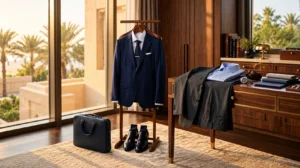
Business formal (sometimes called traditional business attire) is a matched navy, charcoal or dark grey suit, a white or light-blue shirt, a tie and polished Oxford shoes. It suits boardrooms, senior meetings and formal appointments.
Business professional is slightly looser. It might be the same suit with or without a tie, or a good jacket with tailored trousers. Most standard client meetings and presentations sit here.
Smart business casual is a blazer, tailored trousers, a collared shirt and leather loafers or Derbies, without a tie. It suits a workplace you know to be relaxed, an informal lunch or an internal meeting. It is not weekend clothing. Think structured and pressed, not a resort holiday.
If you can’t tell where a meeting falls, aim for the more polished end of the likely range. A jacket can always come off, but you can’t fix arriving underdressed.
If you want a proper suit for regular meetings, we cover the range in our guide to business suits in Abu Dhabi.
What to Wear for Different Types of Business Meetings
Everything below is editorial guidance based on convention and common sense, not official regulation.
Client Meetings
For a first meeting with a client, a navy suit, white or light-blue shirt and polished leather shoes is a safe choice. It looks professional without seeming stiff. A tie makes sense if the client is senior or the office is formal. If you are visiting a firm you know is relaxed, or you have met the client before, you can leave the tie at the hotel. What to wear to a client meeting in Abu Dhabi mostly comes down to how much you know about the client.
Board Meetings
This is the least ambiguous category. A matched suit in charcoal or dark navy, a white shirt, a restrained tie and Oxford shoes is the expected look. Save personality for another day, because a boardroom usually calls for a more restrained and conventional approach.
Government Meetings
Official visitor guidance says to cover shoulders and legs at government offices, and to dress more conservatively during Ramadan. Nothing in that guidance mandates a suit. But for a scheduled appointment, particularly a senior one, a navy or charcoal suit with a long-sleeved shirt and polished closed shoes is a sensible default. Add a tie if the meeting is formal or the officials are senior. If you are asking what to wear to a government meeting in Abu Dhabi and have nothing else to go on, this is the safe answer.
Finance and Banking Meetings
Banks and investment firms tend to lean traditional. A dark matched suit, white or light-blue shirt and a conservative tie work well, especially for lending, advisory or investor meetings. Skip anything fashion-forward here, such as light linen suits or statement loafers.
Legal and Professional Services Meetings
Law firms and consultancies vary with the situation. External client meetings and anything involving partners call for a matched suit and usually a tie. An internal working session may be fine in a jacket and trousers. A plain white or light-blue shirt, no bold pattern, keeps you on safe ground.
Job Interviews
Aim one step smarter than the company’s everyday dress. If you can’t find out what that is, or the role is client-facing, senior or in finance, law or government, wear a suit. Turning up casual because the company seems modern is a mistake you don’t get to correct.
Business Presentations
Your audience decides this one. For external clients or leadership, wear a suit, with a tie if the room is formal. For an internal team with a relaxed culture, a good jacket and tailored trousers can work. Make sure the jacket lets you move your arms without pulling, because you’ll be gesturing for an hour.
Business Lunches
A blazer with tailored trousers, an open-collar shirt and leather loafers or Derbies works for most lunches. If the lunch follows a formal morning meeting, or there are senior guests, stay in the suit. You can loosen the tie later if the mood allows it.
Corporate Networking Events
Read the invitation carefully. “Business attire”, “business casual” and “cocktail” mean different things. A suit is the safe option for business attire events. Blazer and trousers suit business casual ones. If you are unsure, wear the suit and keep the tie in your pocket until you see what others are wearing.
Smart-Casual Business Meetings
When you know the meeting is smart-casual, a blazer, tailored trousers and a collared shirt is the standard. Keep it neat and covered. Beachwear, shorts and flip-flops don’t belong here, and ADGM’s dress policy specifically prohibits beach attire.
What Suit Colour Should You Wear to a Business Meeting in Abu Dhabi?
No single colour is right for every meeting, but some are easier to get away with.
Navy is the most flexible. It suits client meetings, interviews and presentations without looking severe. Stay with deep navy rather than a bright royal blue.
Charcoal is more serious. It works well for boardrooms, banking, legal work and senior meetings.
Medium grey is a good daytime choice for professional settings, as long as the shirt, shoes and fit stay conservative.
Dark grey sits close to charcoal in formality. Avoid shiny cloth or an obvious weave that makes it look like eveningwear.
Black is better for evening events than for daytime business. It can look stark or ceremonial in an ordinary meeting, so it’s rarely the right first choice.
Brown and lighter neutrals suit relaxed, daytime settings such as a creative business or a casual lunch. They are a riskier bet for a board, banking or government meeting.
ADGM’s premises guidance refers to a “dark and/or neutral” business suit for non-GCC men. It does not name a particular shade, so don’t read more into it than that.
What Shirt Should You Wear?
White is the most useful shirt in a formal setting. It works with every suit colour and leaves the tie decision open. Light blue is a close second, and it is a good choice for client meetings and presentations.
Fine stripes and subtle textures are fine once you know the room. For a first meeting, an interview or a conservative office, a plain white or light-blue shirt removes any uncertainty. Skip contrast collars, bold checks and visible logos.
Long sleeves are the sensible default. They fit the conservative baseline and look better under a jacket.
Should You Wear a Tie?
Sometimes. Use it when the setting is formal: a board meeting, a senior client, a government appointment, a bank or law firm, or a formal presentation. Also wear one if you don’t know the host and the office is a corporate one.
You can usually skip it in a confirmed smart-casual office, at a business lunch or at a relaxed networking event. If a host you’ve just met arrives without one, you can take yours off.
ADGM makes a useful example of why this can’t be reduced to a rule. Its dress-code document lists a suit with jacket, trousers, shirt and tie as acceptable for non-GCC men, but it also allows smart casual attire. So the answer is “either is allowed” rather than “a tie is required”.
What Shoes Should You Wear?
Oxfords are the most formal option and the safest for boards, government meetings, banks and interviews. Black goes with charcoal and dark grey. Dark brown pairs well with navy and medium grey.
Derbies are slightly more relaxed but appropriate for nearly all professional situations if they are clean and polished. They are a reliable choice for a client or presentation day.
Loafers suit a business lunch or a known smart-casual meeting. Choose structured leather ones. Soft driving shoes and casual suede styles look out of place when there is business at stake.
Whatever you wear, match your belt to your shoes, wear dark socks long enough to cover your legs when seated, and make sure the shoes are polished. Trainers and sandals are poor choices for anything formal.
What About Cultural Expectations in Abu Dhabi?
The main theme is modesty. Experience Abu Dhabi’s guidance points to conservative, modest choices in business, and its visitor advice is to cover shoulders and legs at government offices. In practice, that means long trousers, a collared shirt, clothes that aren’t transparent or revealing, and nothing with offensive slogans or imagery. ADGM’s dress policy says the same for its premises, and adds that men should be neatly groomed.
Ramadan is worth planning for. Official visitor guidance recommends dressing more conservatively during the month, and ADGM’s Ramadan operating guide asks businesses on Al Maryah Island to ensure that employees’ clothing covers shoulders, chest and knees. That last point is an ADGM policy, not a rule for every employer in the emirate, so it’s worth checking with your host. For formal meetings, err toward long sleeves or a jacket and quiet colours.
You may see Emirati colleagues in the kandura, ghutra and agal. This is national dress, and it isn’t something visitors need to imitate. Wear your own professional clothes and wear them well.
One practical point: Abu Dhabi is hot outside and air-conditioned inside, sometimes very cold. A jacket is often useful even when it feels unnecessary on the walk from the car. A lightweight, breathable cloth helps, and our guide to suit fabrics for the UAE climate explains what to look for.
What to Avoid Wearing to a Business Meeting in Abu Dhabi
Some of these come from official sources, and some are just experience.
From official guidance: beachwear, transparent or revealing clothing, and offensive slogans or images are not acceptable at ADGM. Visitor guidance also says to cover shoulders and legs at government offices, which rules out shorts.
From editorial experience:
- Flip-flops, sandals and trainers in a formal or unfamiliar setting
- Loud prints and large visible branding
- Wrinkled shirts, scuffed shoes and untidy hems
- Clothes that don’t fit, such as tight shoulders, strained buttons or trousers that pool over the shoe
- Too much jewellery, an oversized watch or a showy pocket square
Fit is worth a moment’s thought. A suit that fits well does more for your appearance than an expensive one that doesn’t, whether you buy tailored suits or off the rack. If you’re weighing the two, our comparison of custom vs ready-made suits covers the differences.
A Simple Way to Decide What to Wear
When you’re stuck, run through these six questions:
- Check the invitation. If it names a dress code, follow it.
- Check the host or company. A law firm, a bank and a start-up are not the same.
- Consider the venue. A government office or boardroom calls for more polish than a hotel café.
- Consider who will be there. Senior officials or executives push things more formal.
- Is it a first meeting? If so, lean smarter than you think you need to.
- Still unsure? Start slightly more formal. A jacket you don’t need is easier to deal with than one you don’t have.
Frequently Asked Questions
What should a man wear to a business meeting in Abu Dhabi?
It depends on the host and setting. For a first, formal or unfamiliar meeting, a navy or charcoal suit, a white or light-blue shirt and polished leather shoes is a dependable choice.
Should I wear a tie to a business meeting in Abu Dhabi?
Wear one for formal, senior, government-facing, banking or legal meetings, or if you’re unsure. Skip it if you know the setting is smart casual, such as a lunch or a relaxed office.
Is a navy suit appropriate for a business meeting in Abu Dhabi?
Yes. Navy is a flexible colour for client meetings, interviews and presentations. It isn’t an official requirement, just a reliable option.
Can I wear a blazer instead of a suit in Abu Dhabi?
In a confirmed smart-casual setting, at a lunch or in an internal meeting, yes. For formal, senior or unfamiliar meetings, wear the suit.
What should I wear to a government meeting in Abu Dhabi?
Official guidance is to cover shoulders and legs and dress conservatively. A long-sleeved shirt, tailored trousers and polished closed shoes are a sensible baseline. Add a jacket and tie for formal or senior appointments.
What should I wear to an ADGM meeting?
ADGM’s published policy lists a dark or neutral suit with tie as acceptable for non-GCC men, and also allows smart casual attire. Beach attire isn’t permitted. Check the host’s expectations too.
Is business casual acceptable in Abu Dhabi?
In many workplaces, yes, especially for lunches and internal meetings. It still means neat, covered and structured. For first meetings with formal hosts, go smarter.
Final Thoughts
Fit problems like these aren’t really about bad luck with sizing. They’re the predictable result of a garment built for an average body meeting a body that isn’t average which, in practice, describes almost everyone. A skilled tailor can solve some of this through alteration. The rest genuinely needs to be drafted from the start with your specific shoulders, posture, and proportions in mind.
If you’ve been living with a suit that never quite sits right, it’s worth having someone look at the actual cause rather than continuing to alter around it. [Book a consultation] with TWS and we’ll walk through what’s really going on and what it would take to fix it properly.
Should I dress differently during Ramadan?
Take a more conservative approach. Official visitor guidance advises it, and ADGM has its own modest-clothing requirement for employees on its premises. Confirm with your host if you’re unsure.
Final Thoughts
Fit problems like these aren’t really about bad luck with sizing. They’re the predictable result of a garment built for an average body meeting a body that isn’t average which, in practice, describes almost everyone. A skilled tailor can solve some of this through alteration. The rest genuinely needs to be drafted from the start with your specific shoulders, posture, and proportions in mind.
If you’ve been living with a suit that never quite sits right, it’s worth having someone look at the actual cause rather than continuing to alter around it. [Book a consultation] with TWS and we’ll walk through what’s really going on and what it would take to fix it properly.
Final Takeaway
There’s no one correct outfit for every business meeting in Abu Dhabi. Find out what you can about the host, the venue and the people in the room, and dress a notch smarter than you think you need to when you can’t. If you want help building a wardrobe for regular meetings, you can visit The White Stripes Tailors & Shirtmakers Abu Dhabi or book a consultation.

Asif
I’m Asif, a men’s tailoring and bespoke specialist at The White Stripes Tailors and Shirtmakers with 15+ years of hands on experience in creating custom clothing and bespoke suits. I focus on delivering perfect fit, comfort, and modern style for every client that works for the UAE weather and beyond.
I work closely with clients to understand their preferences and guide them in selecting the right fabrics, designs, and fittings for both formal and casual wear. My approach combines traditional tailoring techniques with current fashion trends to ensure high-quality results.
Through The White stripes, I also share practical insights on suit fabrics, styling tips, and tailoring guidance to help customers make confident choices.
All Posts
Written By:
Recent blog posts
How Bespoke Tailoring Fixes Collar Gap, Dropped Shoulders, and Athletic Builds
Asif
September 21, 2026
Read More »
Side Adjusters vs. Belt Loops: The Sartorial Guide to Men’s Custom Trousers in the UAE
Asif
September 21, 2026
Read More »