

Last updated: September 21, 2026
Every fitting eventually comes down to a handful of small decisions that most clients never expect to matter and the waistband is one of them. Lapel width, jacket length, shoulder shape: these get all the attention. But ask any tailor which detail quietly makes or breaks how a pair of trousers wears through a long Dubai day, and you’ll usually hear the same answer. It’s the waistband system.
Side adjusters or belt loops. It sounds like a minor construction choice, but it changes how the trouser sits, how it photographs, how it feels through a long day in Dubai, and how polished the trousers look when you stand and move, and whether it reads as bespoke or off-the-rack the moment you stand up from your desk. This guide walks through both systems properly what they are, how they behave, and which one actually suits the trousers you’re having made.
What Are Side Adjusters?
Side adjusters sometimes called side tabs, side straps, or strap-and-buckle closures are a built-in fastening system sewn into the left and right sides of the waistband. Their entire purpose is to let you fine-tune the waist without a belt anywhere near the equation.
Mechanically, there are a few variations you’ll come across:
- Buckle-Style Adjusters: Use a fabric strap that threads through a small metal buckle; pulling it tightens the waistband by folding a little excess fabric inward.
- Button-Style Adjusters (Daks Tops): Use a fabric tab that fastens onto one of two or three buttons, with elastic webbing built into the waistband giving a bit of give.
- Slide-Buckle / D-Ring: Allows small, continuous adjustments rather than fixed button positions.
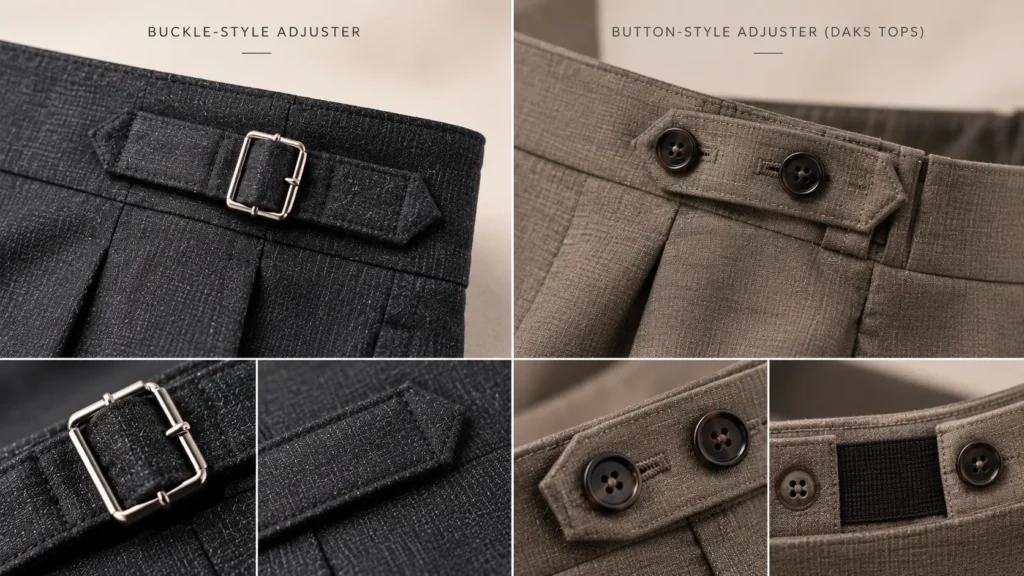
None of these are designed for dramatic resizing. You’re typically looking at a total adjustment range of 1 to 2 inches, split between both sides enough to handle a heavier lunch or a slightly different mood that morning, not enough to compensate for genuine weight change. That’s worth understanding before you commit to them, because it shapes how they should be fitted in the first place.
What side adjusters do exceptionally well is preserve a clean waistline. No belt means no horizontal interruption between jacket and trouser the eye reads one continuous line instead of two separate pieces stitched together by a strip of leather. They also depend on rise. Side adjusters work because the waistband sits at the natural waist, where the body itself provides enough shape to keep things anchored. Try the same system on a low-rise trouser and it has nothing to grip which is exactly why you rarely see adjusters below the navel.
What Are Belt Loops?
Belt loops need less explanation, if only because they’ve been standard on trousers for over a century originally a workwear and military detail before making their way into everyday civilian dress. A typical trouser carries between five and seven loops, spaced evenly around the waistband, sized to suit whatever width of belt the trouser is designed to pair with.
Their job is straightforward: hold a belt in position so it can do the actual work of keeping the trousers up. But loops also do something adjusters can’t they turn the waist into an opportunity for personal styling. A belt lets you introduce texture, colour, and hardware into an outfit, and lets you coordinate leather across belt, shoes, and even a watch strap or bag. For a lot of men, that flexibility is the whole appeal.
Side Adjusters vs. Belt Loops: The Core Comparison
Feature | Side Adjusters (Side Tabs) | Belt Loops |
Visual Line | Unbroken, elongated leg profile | Horizontal line breaks upper and lower body |
Adjustment Range | ~1 to 2 inches (fine-tuning) | Multiple belt-hole positions |
Ideal Trouser Rise | Mid to High rise (natural waist) | Mid to Low rise |
Gulf Climate Comfort | Less bulk around the waist | Warmer around waistband during summer |
Formality | Bespoke suits, tuxedos, DIFC formalwear | Business-casual, odd trousers, chinos |
Bulk Under Jacket | Completely flat and flush | Buckle adds visible forward bulge |
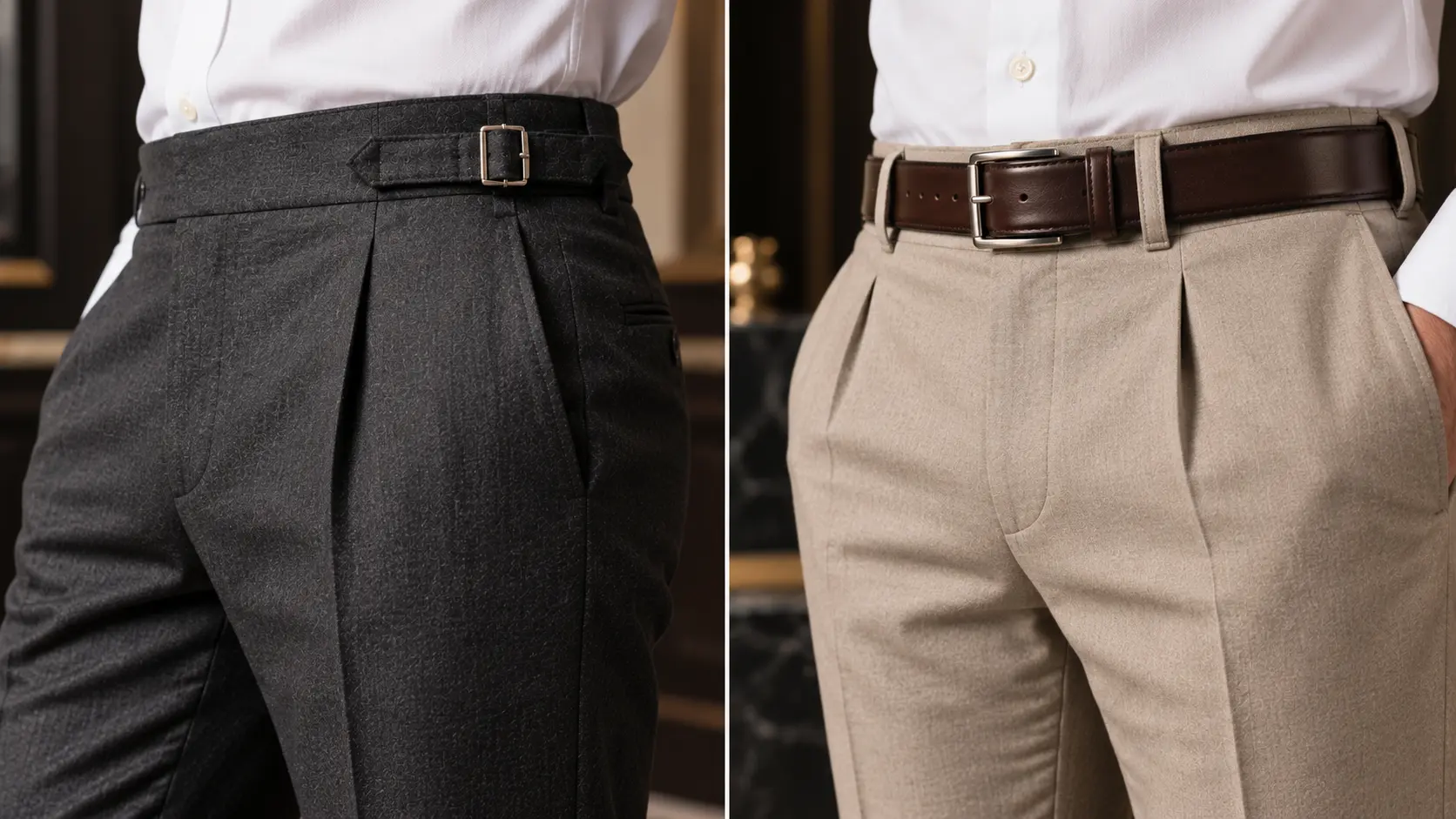
Side adjusters give you a snugger, more tailored fit with none of the bulk a belt buckle adds under a jacket, and they’re generally more comfortable over a long day since there’s no strap compressing the entire waist a real consideration once the temperature climbs. What they don’t give you is much room to move. A belt, by contrast, can be adjusted across five or more holes, which makes it far more forgiving if your weight shifts through the year, and it remains far more versatile it works with suits, chinos, jeans, anything with loops sewn in.
On formality, side adjusters generally read as the more refined option, which is why they’re the traditional choice for bespoke suiting, tuxedos, and black-tie trousers. Belt loops are perfectly acceptable for business suits and are the default for everything business-casual and below. Neither is “wrong” they’re built for different jobs.
When Side Adjusters Make Sense
Side adjusters can be a good choice if a clean, formal silhouette matters more to you than maximum flexibility. If you’re the kind of man who’d rather not think about matching a belt to your shoes every morning, they remove that decision entirely. They also tend to suit a slimmer or more athletic build particularly well, since the trouser can sit properly at the natural waist without a belt fighting against the shape of the body.
There’s a practical argument for side adjusters in this part of the world too long days in serious heat make a belt around the entire waist genuinely uncomfortable, and cutting that out is one less source of friction, literally. If what you want is a tailored, made-to-measure trouser that doesn’t lean on an accessory to finish the look, side adjusters are worth requesting at the fitting stage.
When Belt Loops Are the Better Choice
Belt loops earn their place when versatility matters more than a razor-clean line. If your weight tends to move around through the year, the wider adjustment range a belt offers is simply more practical than the limited give of a side tab. Men who enjoy belts as part of their wardrobe coordinating leather across belt, shoes, and accessories will get more satisfaction from a trouser built around loops.
Rise matters here as well. If you prefer trousers sitting a little lower, below the navel, loops are the safer choice; side adjusters lose their grip at that height and tend to slip. And if you’re after one trouser that can move between a business suit on Monday and smart-casual with a blazer on Saturday, belt loops give you that flexibility without compromise.
Side Adjusters for Bespoke, Business and Wedding Trousers
Context changes the answer more than personal taste does, so it’s worth going category by category:
- For Bespoke Suits: Side adjusters are generally the preferred route they reinforce the tailored, made-for-you line that’s the entire point of going bespoke in the first place, though belt loops remain a perfectly acceptable alternative for a suit built with everyday practicality in mind.
- For Business Suits: Belt loops are the more common choice simply because they offer more day-to-day flexibility, while side adjusters can be requested to lift the formality a notch further.
- For Wedding Suits and Tuxedos: Side adjusters are strongly favoured traditional tuxedo trousers are cut without belt loops altogether, so adjusters (or suspenders) aren’t just preferred, they’re closer to the expected standard for genuine black-tie construction.
- For Formal Odd Trousers: Worn with a blazer, side adjusters keep things visually clean and avoid the more casual note a belt introduces.
- For Smart-Casual Trousers: Chinos, linen trousers, that kind of thing either system works depending on how dressed-up you want the final look to feel.
How to Use Side Adjusters Correctly
Side adjusters are simple, but they’re easy to get slightly wrong, and getting them wrong shows.
- Start with the trouser fastened and zipped, sitting at your natural waist it should feel close to the body without gripping.
- From there, pull each tab or tighten each buckle evenly, a little at a time, until the waistband sits snugly. Don’t cinch one side harder than the other; uneven tension twists the waistband and it will show in how the trouser hangs.
- Once you’ve set it, move sit down, walk, reach for something. The trouser should hold its position without pulling or digging in anywhere.
Adjust again through the day if you need to. After a heavy lunch or a long stretch sitting in meetings, loosening a touch is completely normal and exactly what the system is designed for.
Belt Pairing Guidelines
If you’re going the belt-loop route, a few rules keep things looking intentional rather than mismatched:
- Match Leathers: Match your belt to your shoes black with black, brown with brown.
- Keep Buckles Subtle: A logo-heavy or oversized buckle undercuts a tailored look fast.
- Mind the Width: Dress belts generally sit around 1.25 inches wide, while casual belts can run a little wider, up to about 1.5 inches.
- Skip the Belt Under Waistcoats: Three-piece suits look cleaner with suspenders under the waistcoat, since a belt buckle adds unnecessary bulk beneath the layers.
What Makes Sense in Dubai's Climate and Dress Culture
Two things shape how this decision plays out locally: the heat, and the standard of dress expected in Dubai’s business and social settings.
On comfort, a belt wrapped around the entire waist through a hot, humid day is simply less pleasant than trousers that don’t need one less to trap heat, less friction, less to think about by the afternoon. Lightweight wool, linen, and cotton-blend fabrics pair naturally with side-adjuster trousers for exactly this reason, particularly through the summer months.
On formality, Dubai’s business environment DIFC boardrooms, client meetings, formal dinners rewards a sharp, tailored look, and side adjusters support that polish without extra effort. That said, belt loops remain the practical, versatile choice for business-casual dressing where an odd trouser and blazer combination benefits from the styling flexibility a good belt provides.
Common Mistakes to Avoid
- Never wear a belt with side adjusters: It adds bulk and undoes the purpose of the system.
- Avoid adjusters on low-rise trousers: Side adjusters need the natural waist to hold onto your frame properly.
- Do not over-tighten: Pulling tabs too tight bunches the fabric at the hips and distorts the trouser drape.
- Be honest about weight shifts: If your waist size fluctuates regularly, belt loops are the more practical long-term choice.
Tailoring Consultations at The White Stripes Tailors & Shirtmakers
Neither system is objectively superior; they’re built to solve different problems, and the right one depends on what you actually need from a pair of trousers. Side adjusters suit the man after a clean, formal line for bespoke suits, black-tie trousers, or wedding attire. Belt loops suit the man who wants styling flexibility or needs a wider adjustment range.
If you are not sure which fits your build or wardrobe, discuss it during your fitting. Come in for a consultation with our master tailors at The White Stripes Tailors & Shirtmakers, and we will help you decide trouser by trouser what belongs on your waistband.
- Dubai Atelier: Shop No. 07, Lake City Tower, Cluster D, JLT, Dubai | Tel: +971 4 591 3330 / +971 50 901 6869
- Abu Dhabi Atelier: Shop No. 01, Hashemi Building, Al Dhafra Street, Abu Dhabi | Tel: +971 2 886 5399 / +971 50 901 6473
- Book an Atelier or Office Consultation: https://whitestripes-tailoring.com/appointment/
Frequently Asked Questions
What are side adjusters on trousers?
Side adjusters are built-in straps or tabs on either side of the waistband that let you tighten or loosen the fit by roughly 1 to 2 inches without wearing a belt.
Do I need a belt with side-adjuster trousers?
No. You should never wear a belt with side adjusters. The adjusters are designed to maintain a clean waistline on their own, and adding a belt creates awkward bunching and unnecessary bulk.
Are side adjusters more formal than belt loops?
Generally, yes. Side adjusters are traditionally associated with more formal tailoring, particularly bespoke suits and black-tie trousers. Belt loops are more versatile and common in everyday business and casual tailoring
What is the better option for Dubai's climate?
For long days in the UAE climate,Side adjusters can feel more comfortable in Dubai’s climate because they reduce the amount of material and hardware around the waist.

Asif
I’m Asif, a men’s tailoring and bespoke specialist at The White Stripes Tailors and Shirtmakers with 15+ years of hands on experience in creating custom clothing and bespoke suits. I focus on delivering perfect fit, comfort, and modern style for every client that works for the UAE weather and beyond.
I work closely with clients to understand their preferences and guide them in selecting the right fabrics, designs, and fittings for both formal and casual wear. My approach combines traditional tailoring techniques with current fashion trends to ensure high-quality results.
Through The White stripes, I also share practical insights on suit fabrics, styling tips, and tailoring guidance to help customers make confident choices.
All Posts
Written By:
Recent blog posts
How Bespoke Tailoring Fixes Collar Gap, Dropped Shoulders, and Athletic Builds
Asif
September 21, 2026
Read More »
Side Adjusters vs. Belt Loops: The Sartorial Guide to Men’s Custom Trousers in the UAE
Asif
September 21, 2026
Read More »