
Last updated: October 13, 2026
Most suits can be improved with alterations, but not all of them can be fixed. Sleeve length, trouser length, waist, seat and leg width are routine adjustments. Shoulders, chest, jacket length, rise and major style changes are far more limited, and some are rarely worth attempting. What is possible depends on the garment itself: how much fabric sits inside the seams, how the jacket is built, and how far the suit is from your actual measurements.
If you are searching for suit alterations in Dubai, the first step is to understand what the garment can realistically accommodate. A good tailor will tell you what can be done, what carries risk, and when a different suit is the better investment.
The principle behind most alteration decisions
Taking fabric away is usually easier than adding it. A tailor can remove excess from a seam, shorten a sleeve or taper a trouser leg without needing material that is not there. Letting a garment out depends on seam allowance, the spare fabric folded inside a seam. Many ready-to-wear suits have very little of it.
A suit that is only slightly too large may be easier to adjust than one that is too small, but the result depends on where the excess fabric sits and how the garment is constructed.
Lining, canvas (the internal structure of the chest and lapel), pocket placement and the cloth itself all affect what is realistic. No article can give universal measurements, because two jackets of the same size from different makers can behave very differently. The points below describe what is usually possible, and every one of them needs confirming on the actual garment.
What can be altered on a suit jacket?
Sleeve length and width
Shortening a sleeve from the cuff is one of the most common jacket alterations. The limit is usually the cuff itself. If the jacket has working buttonholes, shortening the sleeve moves the buttons closer to the edge, and the original buttonholes cannot be closed cleanly without specialist reweaving. Large changes can leave the buttons sitting too close to the cuff edge, or too far from it. Lengthening is sometimes possible, but only if fabric has been left inside the cuff.
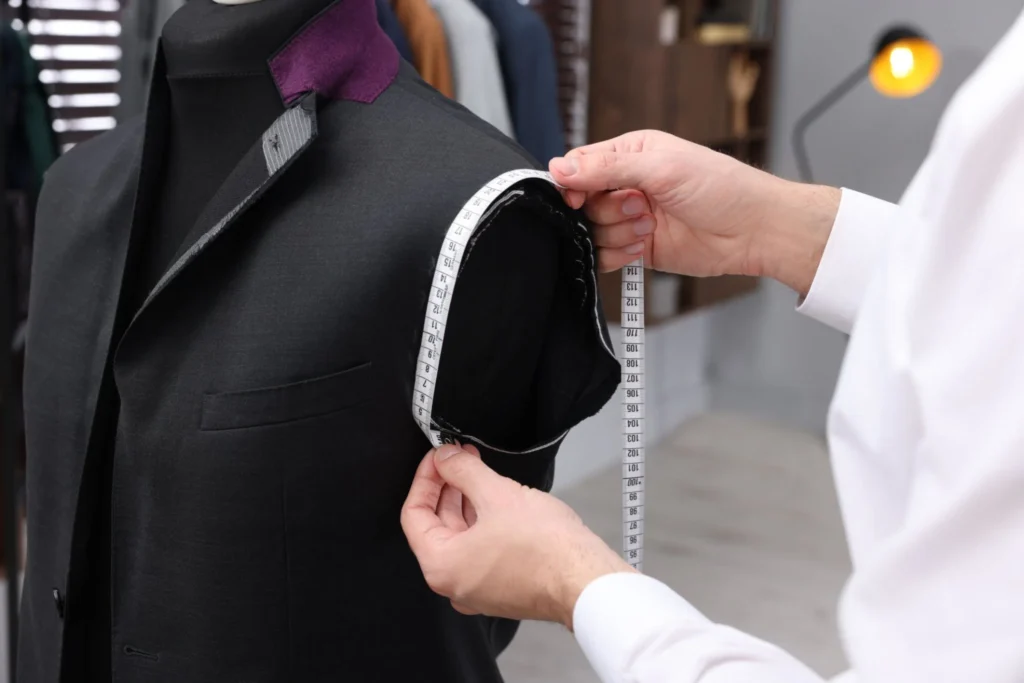
Sleeves can usually be narrowed, particularly below the elbow. Narrowing too close to the armhole can restrict movement or distort the sleeve, so it is a modest adjustment rather than a dramatic one.
Waist and side seams
Taking in the side and back seams is a standard way to reduce the waist and improve the jacket’s shape. Where seam allowance exists, a tailor may be able to let the waist out slightly. Take in too much, however, and the balance changes: pockets and vents can start to look misplaced, and the cloth may pull rather than drape. For a modest adjustment this is straightforward. For a jacket that is several sizes too large, the result tends to look compromised.
Chest
The chest is more limited than the waist. Some jackets allow a small amount of letting out, and Esquire’s guidance puts this at roughly an inch in some cases, but that is a ceiling rather than a promise. A jacket that is noticeably tight across the chest generally cannot be made meaningfully larger, because the allowance, the canvas and the armhole all constrain the work.
Shoulders
Shoulders are the hardest part of a jacket to alter. Padding can sometimes be removed or added to change the shape, but narrowing or widening the shoulder itself means reworking the sleeve head, canvas, armhole and lining together. It is expensive, risks visible distortion, and often leaves the sleeve hanging poorly. This is the main reason shoulder fit should be right before you buy.
Jacket length
Shortening a jacket slightly is sometimes possible, but pockets, vents, the bottom button and the hem allowance all limit how far it can go. Shorten too much and these details end up too close to the hem, which disturbs the proportions. Lengthening is rarely possible, because a jacket does not carry hidden fabric at the hem the way trousers often do.
Buttons, vents, pockets and lapels
Changing these details can affect both the jacket’s appearance and its construction.
- Buttons: Repositioning is possible only in limited circumstances. Converting a three-button jacket to two is generally not clean, because the old buttonholes leave permanent evidence and the lapel roll changes.
- Vents: Closing or reducing an existing vent may be possible. Adding one is generally impractical, as there is usually no spare fabric to form the vent flaps.
- Pockets: Minor repairs are realistic. Relocating pockets is major work that can damage the structure and disturb pattern matching.
- Lapels: Converting a peak lapel to a notch is sometimes possible. The reverse generally is not, because a notch lapel lacks the fabric. Either way, the lapel roll and buttonhole angle may look wrong afterwards.
Collar gap
A collar that lifts away from the neck can sometimes be adjusted, but the cause matters. Posture, shoulder slope and uneven shoulders can all produce the same symptom, and a collar alteration will not fix a gap caused by any of them. It is a case where inspection comes before any promise.
What can be altered on suit trousers?
Trousers are generally more forgiving than jackets.
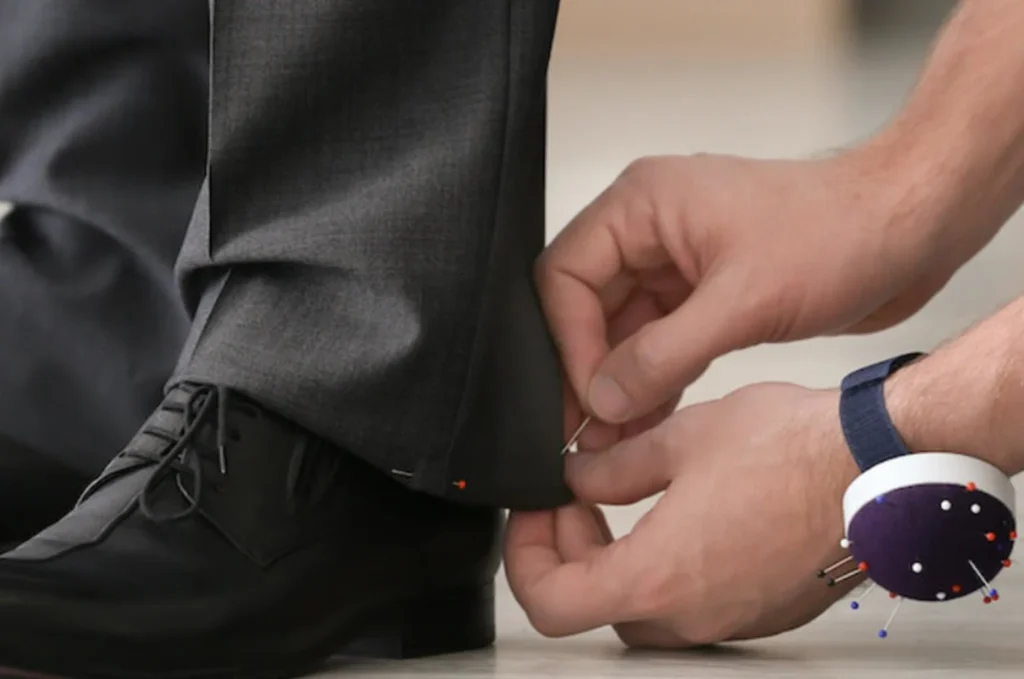
Length and hemming is routine. Shortening is straightforward, and lengthening depends on the existing hem allowance. Turn-ups (cuffs) can often be added or removed where there is enough fabric, which again comes down to what has been left in the hem.
Waist and seat can often be taken in or let out, commonly through the centre-back seam and waistband. One source suggests a few inches may be available there in some trousers, but this varies widely. Large adjustments can crowd the rear pockets or distort the seat, so it is best treated as a modest adjustment.
Leg width can usually be tapered, particularly from the knee to the hem. Over-tapering makes the trousers pull at the knee, and the leg opening should still sit comfortably over your shoes.
Rise and crotch are a different matter. The rise is the distance from the crotch seam to the waistband, and changing it can mean dismantling the waistband, zip and crotch construction. A small extension may be possible where there is enough fabric, but it is costly and risks upsetting the balance of the trousers. Recutting the crotch affects the seat, thigh and rise at the same time. If the rise feels uncomfortable, the tailor should assess whether an alteration can improve it without affecting the rest of the fit.
What can be altered on a suit waistcoat?
Waistcoats are less often discussed, but the same logic applies. The waist can often be taken in or let out slightly through the side seams or back adjustment points, and a back strap or buckle can usually be adjusted or replaced. Length is more limited: shortening may be possible, while lengthening is usually constrained by fabric. Altering the shoulders or armholes is complex, and any change there can affect how the waistcoat layers beneath the jacket.
A quick reference
Alteration | What is usually possible | Important limitations |
Sleeve length | Shortening from the cuff | Working buttonholes complicate large changes |
Sleeve width | Narrowing, especially below the elbow | Too much near the armhole restricts movement |
Jacket waist | Taking in; letting out only if allowance exists | Over-adjusting disturbs pockets, vents and balance |
Chest | Limited letting out or taking in | Often uneconomical if the jacket is tight |
Shoulders | Padding adjustments; seam changes are major work | Complex, costly and often not advisable |
Jacket length | Slight shortening | Lengthening rarely possible; details sit too near the hem |
Vents, buttons, lapels | Closing vents; limited button and lapel changes | Adding vents or changing button count generally impractical |
Trouser length and turn-ups | Shortening; lengthening or adding cuffs if fabric allows | Depends on hem allowance |
Trouser waist and seat | Take in or let out modestly | Large changes crowd pockets or distort the seat |
Leg width | Tapering, especially knee to hem | Over-tapering pulls at the knee |
Rise and crotch | Small changes in some cases | Complex and often uneconomical |
Which alterations are difficult, risky or uneconomical?
A few changes come up repeatedly as poor investments: widening or narrowing shoulders, expanding the chest substantially, lengthening a jacket, changing the button count or stance, adding vents, and changing the rise significantly. Major pocket relocation and lapel conversion belong on the list too. Each can sometimes be done in a technical sense, but each compromises the design or costs more than the result justifies.
A reasonable rule of thumb is that if a suit is more than about one size wrong, especially in the shoulders or chest, alteration is often not the best use of your money. If you want to understand why a particular fit issue appears in the first place, our guide to common suit-fitting mistakes is a useful companion, though it addresses the problems themselves rather than whether they can be corrected.
Ready-made versus bespoke: why flexibility differs
Ready-made suits are produced in standard sizes, and their alteration options vary by maker and construction. Some garments have enough seam allowance for modest adjustments, while others leave little room for letting the fabric out or making more extensive changes. Hemming, waist adjustments and tapering are commonly feasible, but anything that depends on hidden fabric usually is not.
A bespoke suit is made around the wearer and may include fitting allowances, so it tends to be more adaptable. It should still be fitted correctly during the making process rather than corrected afterwards, particularly in the shoulders and chest. For a broader comparison of value, style and comfort, see our guide to custom versus ready-made suits. The point here is narrower: the construction of the garment sets the limits of what can be changed later.
Should you alter your suit or buy another one?
Alteration makes sense when the suit is close in the shoulders and chest and needs only hem, sleeve, waist or taper work. In this situation, the tailor can focus on refining the areas that need adjustment, and the cost is usually modest compared with the result.
Replacement is usually wiser when the shoulders, chest, length or overall proportions are substantially wrong, or when the work needed would cost a significant portion of a new suit. It also applies to a suit whose original pattern no longer suits your build or how you dress. UAE bespoke suits commonly range from AED 2800+, with premium work higher, according to our guide to bespoke suit costs in the UAE. That is a useful benchmark when you are weighing repeated alterations against a suit made to fit from the start.
A few questions help settle it:
- Does the suit fit across the shoulders and chest as it is?
- Would the work involve only the routine adjustments listed above?
- Will the total cost sit comfortably below the price of a better-fitting replacement?
- Do you like the suit enough to keep wearing it afterwards?
Timing matters too. If you need the suit for a wedding or a business event, have it assessed well in advance. Complex work cannot reliably be promised at short notice.
When should you consult a professional tailor?
Before you buy a suit you plan to alter, and before you commit to any change beyond hemming. A tailor can inspect the seam allowance, lining and construction, and diagnose causes you cannot see yourself, such as a collar gap that comes from posture rather than the jacket. For general principles on how a suit should sit, our guide to how a suit should fit is a good reference point.
Delicate or loosely woven fabrics, including some lightweight wools and linens suited to the UAE climate, may need more careful handling, and a tailor can advise on this once they have seen the cloth.
Frequently Asked Questions
Can a suit jacket be altered?
Yes, within limits. Sleeves, waist and side seams, and modest length reductions are the most realistic changes. Shoulders, chest, vents, lapels and buttons are far more restricted.
Can suit shoulders be altered?
Padding can sometimes be adjusted, but changing the shoulder seam itself means reworking the sleeve head, canvas and armhole. It is complex and often not worthwhile.
Can a suit jacket be lengthened?
Rarely. Jackets seldom contain usable spare fabric at the hem, so lengthening is usually impractical.
Can suit trousers be let out?
Often, if the seams and waistband contain spare fabric, commonly at the centre-back seam. The amount varies by garment, and large changes can affect the pockets and seat.
How much do suit alterations cost in Dubai?
It depends on the garment, fabric, construction and complexity. Several UAE providers publish prices for specific services, but a reliable quote requires seeing the suit.
Is it worth altering an inexpensive suit?
Sometimes. Simple work such as hemming or a modest waist adjustment may be reasonable. If the work approaches the cost of a better-fitting suit, replacement is usually the wiser choice.
Have your suit assessed
If you are unsure whether your suit is worth altering, bring it in for an assessment with TWS in Dubai or Abu Dhabi. We can inspect the garment, explain what is realistic, and tell you honestly when a different suit is the better option.

Asif
I’m Asif, a men’s tailoring and bespoke specialist at The White Stripes Tailors and Shirtmakers with 15+ years of hands on experience in creating custom clothing and bespoke suits. I focus on delivering perfect fit, comfort, and modern Style for every client based in the UAE and beyond.
I work closely with clients to understand their preferences and guide them in selecting the right fabrics, designs, and fittings for both formal and casual wear. My approach combines traditional tailoring techniques with current fashion trends to ensure high-quality results.
Through The White stripes, I also share practical insights on suit fabrics, styling tips, and tailoring guidance to help customers make confident choices.
All Posts
Written By:
Recent blog posts
What Can Be Altered on a Suit? A Dubai Tailor’s Guide to What’s Possible
Asif
October 13, 2026
Read More »

What to Wear for a Business Meeting in Abu Dhabi: An Executive Dress Code Guide
Asif
September 25, 2026
Read More »