
Last updated: September 1, 2026
In a city where first impressions open boardroom doors and wedding halls alike, the suit you wear says as much as the words you speak. Abu Dhabi’s business and social calendar — from Corniche boardrooms to Emirates Palace receptions — demands a wardrobe that performs in 45°C heat without sacrificing polish. This guide, written from two decades on the cutting table at The White Stripes Tailors & Shirtmakers, walks you through everything you need to know about bespoke suits in Abu Dhabi in 2026: the process, the fabrics, the fit, and the investment.
1. What Is a Bespoke Suit?
A true bespoke suit is built from an individual paper pattern cut solely for your body — not adjusted from an existing block. It typically involves 2–4 fittings, hand-canvassed construction, and 60–80 hours of hand and machine work. In Abu Dhabi, “bespoke” is often used loosely; ask your tailor whether your pattern is drafted from scratch or pulled from stock blocks — that distinction is the real test.
2. Bespoke vs Made-to-Measure vs Ready-to-Wear
Feature | Ready-to-Wear | Made-to-Measure | Bespoke |
Pattern | Standard block | Adjusted standard block | Individually drafted |
Fittings | 0 | 1 | 2–4 |
Construction | Fused/machine | Semi-canvas usually | Full hand-canvas |
Turnaround | Same day | 2–3 weeks | 2–4 weeks |
Best for | Quick needs | First-timers, budget | Executives, weddings, connoisseurs |
Expert tip: If you’ll wear the suit weekly in Abu Dhabi’s climate, bespoke’s breathable hand-canvas construction pays for itself in comfort and longevity within two summers.
3. The Complete Bespoke Tailoring Process
- Consultation – Lifestyle, climate exposure, and occasion review.
- Fabric selection – From our Abu Dhabi showroom mills (Loro Piana, Scabal, Zegna).
- Measurement & pattern draft – 30+ individual measurements.
- Baste fitting – First skeleton assembly, major structural adjustments.
- Forward fitting – Canvas and shoulders set, sleeves pinned.
- Final fitting – Buttonholes, lining, finishing details confirmed.
- Delivery & pressing – Final steam and quality check.
4. Fabric Guide for Abu Dhabi's Climate
Abu Dhabi’s heat and heavy air-conditioning indoors mean fabric choice matters more than in temperate climates.
Fabric | Weight | Breathability | Best Use in Abu Dhabi |
Tropical wool (S110s–130s) | 180–220g | Excellent | Year-round business |
Wool-mohair blend | 200–230g | Very good | Office + evening |
Linen-wool blend | 230–260g | Excellent | Outdoor summer events |
Pure linen | 200g | Excellent | Weddings, resort wear |
Fresco weave | 210g | Outstanding | Daily commute, humidity |
Expert tip: Avoid pure worsted wool under 150g for daily Abu Dhabi wear — it creases quickly in AC-to-heat transitions. A high-twist tropical wool or Fresco holds shape best.
5. Canvas Construction Explained
- Full canvas: Horsehair/wool canvas floats beneath the cloth, moulding to your body over time — the gold standard for bespoke.
- Half canvas: Canvas in the chest only, fused below — a strong made-to-measure compromise.
- Fused (glued): Common in ready-to-wear; can bubble in Gulf humidity over time.
For Abu Dhabi’s heat, full canvas actually breathes better than fused construction, despite assumptions otherwise.
6. Suit Styles
- Single-breasted, two-button – The versatile Abu Dhabi business default.
- Double-breasted – Popular for gala dinners and Ramadan/Eid formal events.
- Three-piece – Favoured by senior executives for gravitas in meetings.
7. Lapel Guide
Lapel | Character | Occasion |
Notch | Classic, safe | Everyday business |
Peak | Bold, formal | Weddings, black-tie |
Shawl | Smooth, elegant | Tuxedos, evening |
8. Button Styles
Two-button single-breasted remains Abu Dhabi’s boardroom standard. Three-button suits suit taller frames; six-button double-breasted (two-to-button) reads more formal and works well for wedding parties.
9. Trouser Guide
Flat-front trousers are the modern, slimmer choice; single or double pleats suit fuller builds and add comfort in seated, air-conditioned office settings. We recommend a light half-lining in trousers for Abu Dhabi’s heat — it prevents fabric cling without adding warmth.
10. Suit Fit Guide
- Shoulders should sit flush with no divots or pulling — this cannot be altered later, so get it right at the first fitting.
- Jacket length typically covers the curve of the seat.
- Sleeve shows ¼–½ inch of shirt cuff.
- Trouser break — most Abu Dhabi executives now prefer a slight or no break for a modern silhouette.
11. Wedding Suits
Grooms in Abu Dhabi often choose midnight-navy or ivory tuxedos for evening receptions, and lighter dove-grey or beige linen-blend suits for daytime celebrations at venues like Emirates Palace or Yas Island resorts. We recommend booking your first fitting at least 8 weeks before the date to allow for a full bespoke cycle plus alterations for groomsmen.
12. Business Suits
Navy and charcoal remain the Abu Dhabi corporate uniform — versatile for Etihad Towers meetings through to government functions. A tropical-wool navy suit is our most requested piece among executives across ADGM and Khalifa Business Park.
13. Luxury Suit Trends in Abu Dhabi (2026)
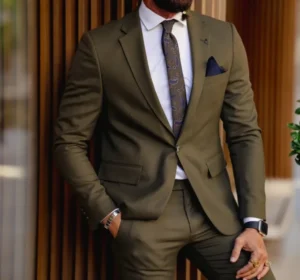
- Muted earth tones and warm greys replacing pure black
- Textured weaves (birdseye, sharkskin) over flat worsted
- Higher-rise trousers with minimal break
- Personalised linings and monogramming as a discreet status marker
14. How Long Bespoke Tailoring Takes
A standard bespoke suit takes 2–4 weeks in Abu Dhabi with three fittings; rush orders (10–14 days) are possible for weddings or urgent travel with a premium.
15. Care and Maintenance
- Rotate suits; avoid daily wear of the same piece
- Use wooden hangers and breathable garment bags — essential given Abu Dhabi’s dust and humidity
- Dry-clean sparingly (2–3 times per season); steam between wears
- Store with cedar blocks to deter moths in humid storage rooms
16. Common Buying Mistakes
- Choosing fabric weight suited to Europe, not the Gulf
- Skipping fittings to save time
- Prioritising trend over proportion
- Assuming “bespoke” pricing guarantees a hand-drafted pattern — always ask
17. Why Invest in Bespoke Tailoring
A bespoke suit is engineered for your posture, movement, and climate — not approximated. Over its lifespan it can be let out, re-cut, and re-lined, often outlasting three ready-to-wear replacements, making it the more economical choice for anyone dressing formally year-round in Abu Dhabi.
Frequently Asked Questions
What is the difference between bespoke and made-to-measure?
Bespoke uses an individually drafted pattern; made-to-measure adjusts an existing block.
How many fittings does bespoke tailoring require?
Usually 2–4 fittings.
What fabric is best for Abu Dhabi's climate?
Tropical wool, Fresco weave, or wool-linen blends.
How long does a bespoke suit take to make?
Around 2–4 weeks on average.
Can I get a bespoke suit rushed for a wedding?
Yes, many tailors including The White Stripes offer 10–14 day rush services.
What is canvas construction?
An internal structure of horsehair or wool that shapes the jacket and improves drape.
Is a three-piece suit still fashionable?
Yes, especially for senior executives seeking added formality.
What colour suit is best for Abu Dhabi business settings?
Navy and charcoal remain the standard.
Should I choose pleated or flat-front trousers?
Flat-front for a modern fit; pleated for comfort and fuller builds.
How often should I dry-clean a bespoke suit?
2–3 times per season; steam instead between wears.
What's the best lapel style for weddings?
Peak lapels for formal evening events.
Can bespoke suits be altered later if I lose or gain weight?
Yes — bespoke suits generally have more fabric allowance for future alterations.
Why choose bespoke over ready-to-wear in Abu Dhabi's heat?
Breathable canvas construction and climate-matched fabric perform better than fused, off-the-rack garments.
Why Choose The White Stripes Tailors & Shirtmakers
At The White Stripes Tailors & Shirtmakers, every bespoke suit begins with a conversation about how you actually live and work in Abu Dhabi — not a generic template. Our master tailors hand-draft each pattern, select fabric engineered for Gulf conditions, and guide you through every fitting personally.
Book your bespoke consultation with The White Stripes Tailors & Shirtmakers today — because a suit built for Abu Dhabi should be cut in Abu Dhabi.

Asif
I’m Asif, a men’s tailoring and bespoke specialist at The White Stripes Tailors and Shirtmakers with 15+ years of hands on experience in creating custom clothing and bespoke suits. I focus on delivering perfect fit, comfort, and modern Style for every client based in the UAE and beyond.
I work closely with clients to understand their preferences and guide them in selecting the right fabrics, designs, and fittings for both formal and casual wear. My approach combines traditional tailoring techniques with current fashion trends to ensure high-quality results.
Through The White stripes, I also share practical insights on suit fabrics, styling tips, and tailoring guidance to help customers make confident choices.
All Posts
Written By:
Recent blog posts
What Can Be Altered on a Suit? A Dubai Tailor’s Guide to What’s Possible
Asif
October 13, 2026
Read More »
What to Wear for a Business Meeting in Abu Dhabi: An Executive Dress Code Guide
Asif
September 25, 2026
Read More »