

Last updated: October 27, 2026
You are standing in front of the mirror in a jacket held together with white thread, one sleeve loosely attached, chalk marks across the chest. The tailor asks how it feels. What matters now?
Mostly, three things: whether the overall shape and proportions are heading in the right direction, whether anything is uncomfortable, and whether you understand the corrections that have been agreed. A first fitting is rarely an approval of a finished suit. It is a decision to let the work continue on a sound footing. This first bespoke suit fitting checklist covers what to inspect, what to report and what to confirm before you leave.
What Happens During Your First Bespoke Suit Fitting?
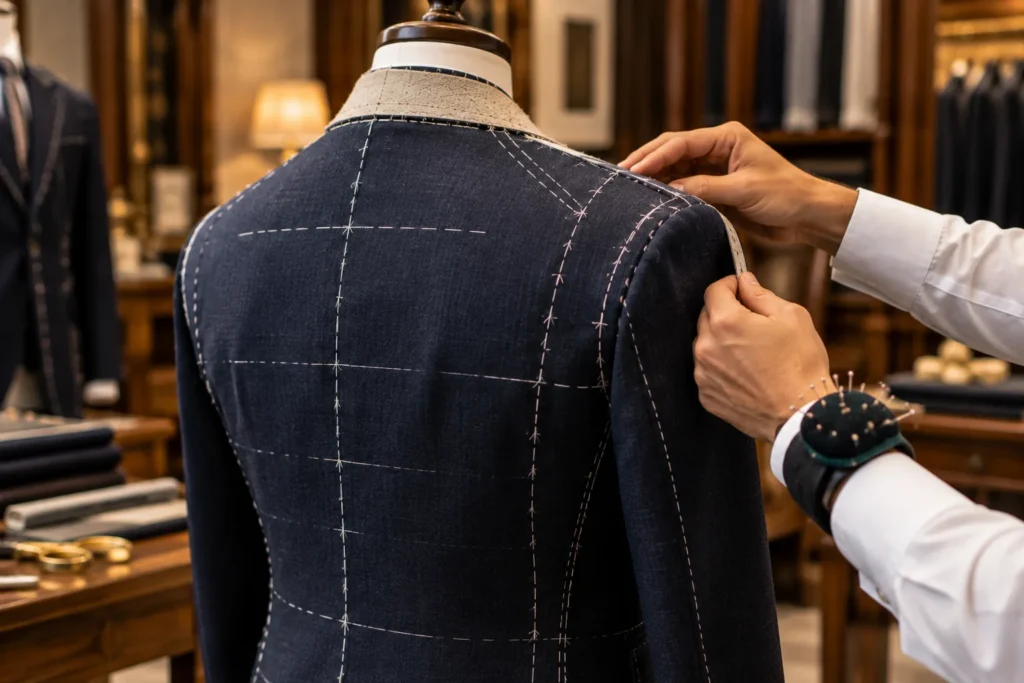
The first try-on of a bespoke garment is usually a basted fitting. The jacket is roughly assembled with temporary stitches, so the cutter can judge balance, proportion and shape on your actual body while the cloth is still easy to open up and adjust. The cutter marks changes with chalk and pins, and the garment is then reworked to include them.
Not every tailoring house follows that sequence. Some start with a forward fitting for clients whose figures suit it, which means a more developed garment that shows the design more clearly from the outset. Permanent Style has documented both approaches, and neither is a measure of whether a suit is truly bespoke. What matters is knowing which stage you are attending and what it is meant to test. If you are unsure, ask at the start of the appointment.
Depending on the house and the stage, you may see visible basting thread, raw edges, loosely attached sleeves, a temporary collar, or pockets, buttons and lining that have not yet been added. None of this is a defect. Please don’t pull at the stitching either; some of it is holding the garment together for the fitting. If you would like the broader picture of how an initial appointment unfolds, our guide to what happens during your first bespoke suit appointment covers it. This article picks up at the point where you have to decide whether to let things proceed.
What Should You Check on the Jacket?
Start with the whole garment, then work towards the details. Finishing touches such as buttonholes can wait. Proportion and comfort cannot.
A useful principle: describe what you see and feel, and leave the diagnosis to the cutter. Similar wrinkles can have several causes, and a fold that looks like spare cloth may be there for balance. Taking material away can make a jacket tighter without curing the problem.
What Should You Check on the Jacket?
Look at the shoulder line from the front, then ask to see the side and back. You are checking whether it looks deliberate: no collapsing at the ends, no sleeve being pulled by the shoulder, no unwanted overhang. Some extension beyond the natural shoulder is a style choice in certain houses, so the seam need not sit at one exact point.
Notice also whether the jacket seems to hang as a coherent whole, or appears to tip, buckle or sit unevenly. Shoulders can differ in height and slope, and the jacket may be cut to accommodate that. Ask the tailor to talk you through what they are seeing rather than assuming the hem tells the whole story.
Collar and neckline
Wear the shirt you intend to wear with the suit. At rest, the jacket collar should sit cleanly against the shirt collar. A gap that opens at the back, pressure at the neck, or ridging just below the collar are all worth mentioning. Collar behaviour is tied to the balance of the whole jacket, so it is rarely a matter of simply adjusting the collar itself.
Chest, waist and closure
Fasten the jacket at the intended point and breathe normally. You should not feel pressure, and the cloth should not pull or distort around the button. A draped chest is not automatically too much fabric. Equally, a waist shaped so tightly that every fold disappears while you stand still will probably be uncomfortable once you sit down. Tell the tailor where the tension is and when it appears.
Length and buttoning position
These are the decisions to raise early. Jacket length and the position of the fastening shape the whole silhouette, and altering them gets harder as construction advances. Seat coverage is a common reference point for length, but it is a convention and a matter of taste, not a rule. Say what you prefer, and ideally why: a more contemporary proportion, or something closer to a traditional line.
Sleeves, armholes and movement
With your arms hanging naturally, look for twisting or persistent diagonal creases in the sleeves. This relates to what tailors call sleeve pitch, the way the sleeve is set in relation to your natural arm angle. You do not need to name it; just describe what you see. Armholes should not pinch, and the jacket should not lift excessively when you move gently. A higher armhole is not automatically better, because an armhole cut too high can create its own pressure and folds.
Back fit and natural posture
Ask for the back view, and stand as you normally do, not as you would for a photograph. Stand artificially upright and the fitting is judged against a posture you do not keep. Look for pulling or gaping across the back. A little fullness below the armhole is often functional ease that lets you move, so resist the urge to remove it.
If you would like more on the principles behind a well-fitting suit more generally, our guide to getting a well-fitting suit in Dubai is a good companion.
What Should You Check on the Trousers?
Trousers get less attention than jackets at a first fitting, and they are where many people live with discomfort for years. Treat this as your trouser fitting checklist.
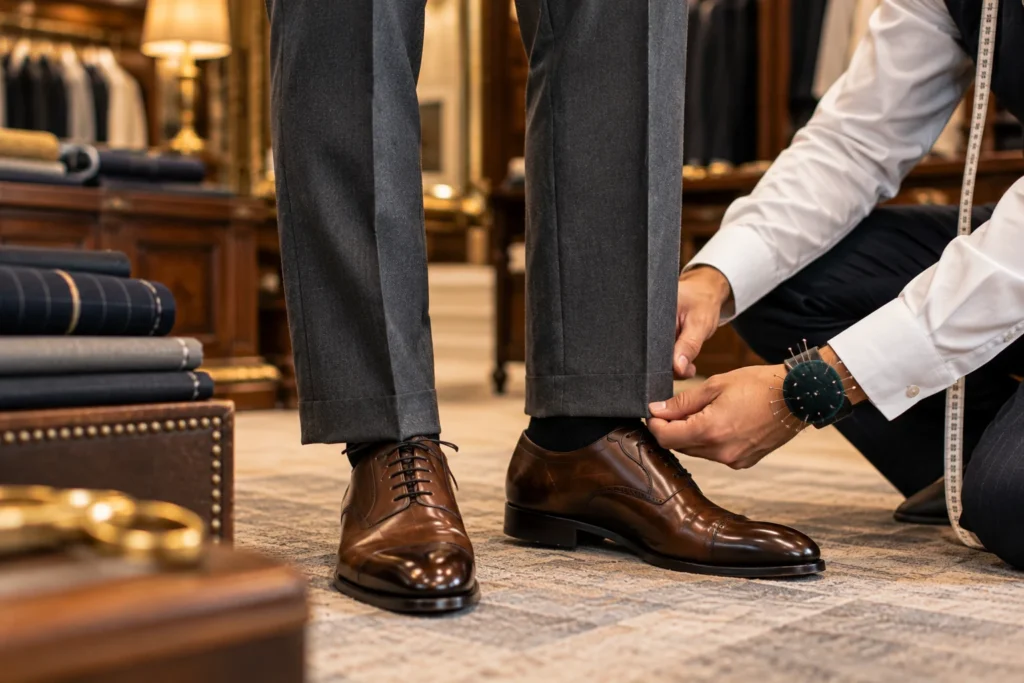
Waistband and rise. The waistband should sit securely at the height you agreed without a belt forcing it into place. Rise is the distance from the crotch to the waistband, and it affects both where the trousers sit and how comfortable you are when seated. Report slipping, digging in, or pressure.
Seat and thigh. Check the front, side and back views, then think about sitting. Permanent Style’s trouser guide makes the useful point that thigh room has a direct bearing on seated comfort. A fashionably narrow leg should not cost you the ability to sit down properly.
Leg shape and taper. Straight, tapered or fuller legs are all legitimate choices. Look at the line from thigh to knee to hem and ask whether it matches the silhouette you wanted.
Length and break. Break is the way the trouser hem meets the shoe. How much is a matter of taste, and there is no single correct amount. What matters is that you agree it with the tailor while wearing the shoes you will actually wear, because shoe shape and heel height change where the hem rests. If you alternate between very different shoes, say so, so that any compromise is deliberate.
Behaviour in motion. If the tailor is happy for you to walk a few steps, notice whether the fabric catches, twists or gathers. Describe where and when it happens. Whether the cause is length, leg shape or balance is for the cutter to judge.
Should You Test Movement During the First Fitting?
Yes, but only within limits, and only with the tailor’s agreement. A basted or pinned garment is not built to take unrestricted movement, and some parts may be held with temporary stitching.
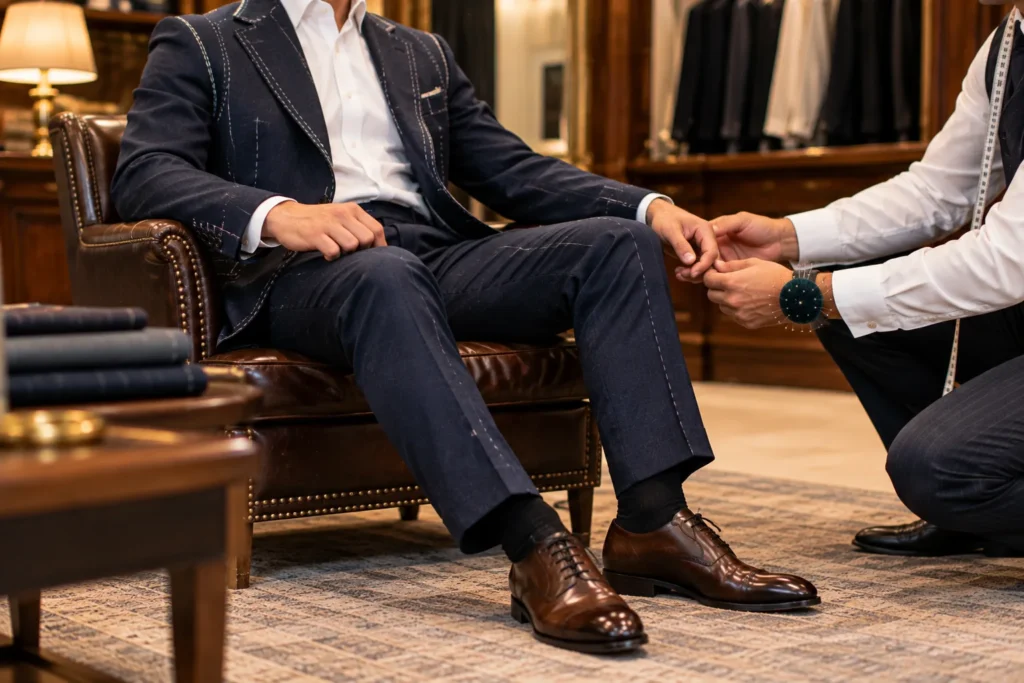
Ask first: “Is it safe to sit, or to reach forward?”
If the answer is yes, a sensible sequence is to stand naturally, walk a few steps, sit, reach forward gently and raise your arms moderately. You are looking for restriction across the back, pressure at the armholes, and trousers that dig in or catch when you sit. If your daily routine involves a particular movement, such as shaking hands, gesturing in presentations or reaching across a desk, mention it.
A tailored jacket will not stay motionless through every arm movement. The aim is comfortable, ordinary movement, not a jacket that looks identical standing still and with both arms overhead. A suit that is close and neat at rest but restrictive in use is a poor trade for most people.
What Should You Bring to Your Fitting?
The more closely the fitting resembles real wear, the more useful it is.
- The shirt you intend to wear, or one with a comparable collar and cuff, so collar and sleeve are judged correctly.
- Your actual dress shoes, for the reasons given above.
- A belt, if the trousers are designed to be worn with one.
- Relevant layers. If the commission includes a waistcoat, bring what you will wear beneath it.
- Accessories that affect the look, such as a tie, bow tie or cufflinks, particularly for formal occasions.
- A reference garment or a few photographs. An existing jacket you like helps you explain length, waist shape or lapel character. Photographs are best treated as conversation aids, since a cut seen on another person’s body may not translate directly to yours.
It also helps to describe how the suit will be used and when you need it. A suit for long days at a desk, a wedding with hours of standing and photographs, or frequent travel each raise different questions. Grooms may want to read our page on wedding suits in Dubai alongside this one.
What Questions Should You Ask Before Approving the Fitting?
Before you leave, you should understand what happens next. These questions are suggestions for the conversation, not statements of any house’s policy. The answers must come from your tailor.
On the corrections:
- What changes have you marked today?
- Which are fit corrections, and which are changes to the silhouette I asked for?
- Is this pulling or fullness temporary, or something you intend to correct?
On what is still open:
- Which parts of the garment are still provisional?
- Are the jacket length, buttoning position and trouser waistband position agreed?
- Can this issue still be adjusted at this stage, and what are the limits?
On the road ahead:
- What should we specifically recheck at the next fitting?
- If this concern remains, what is the next step?
- When is the next appointment, and what completion date are we working towards?
- Are there charges or policy limits I should understand before requesting further changes?
If an event date is fixed, say so early. A wedding or a start date at a new job changes how much room there is for another fitting.
Common Mistakes to Avoid at Your First Fitting
Staying quiet about discomfort. Politeness is not helpful here. If something pinches, restricts or feels wrong, say where and when. The tailor can only act on what they know.
Judging the suit while standing still. A suit that looks excellent in a static pose may be uncomfortable seated. Where the tailor agrees, check how it behaves in the ways you will actually use it.
Mistaking temporary construction for a flaw. Basting thread, chalk and missing linings are part of the stage. Ask what is temporary and what will change.
Prescribing the repair. “Take in the sides” or “lower the armhole” may be wrong for the cause. Describe the symptom and let the cutter choose the remedy.
Chasing every wrinkle. Some creasing is ease, and ease is what lets you move. The question to ask is whether a fold is unwanted pulling or simply the cloth doing its job.
Forgetting the trousers. They are easy to leave until last, when the conversation has already moved on. Allow time for them.
First Bespoke Suit Fitting Checklist
Save this on your phone for the appointment.
Before the fitting
- Confirm which stage this is: basted, forward or another.
- Wear or bring the intended shirt and shoes.
- Bring the belt, layers and accessories you plan to use.
- Note the occasion, the event date and the silhouette you prefer.
During the fitting
- Stand naturally and review front, side and back.
- Discuss shoulders, collar and overall balance.
- Confirm jacket length and buttoning position.
- Report any restriction in the chest, waist, armholes or sleeves.
- Check trouser waistband, rise, seat and thigh comfort.
- Agree the leg shape and preferred break.
- Try only the movements the tailor says are safe.
- Ask what is temporary and what needs correcting.
Before leaving
- Recap the agreed alterations.
- Record any concern that is still unresolved.
- Clarify which decisions remain provisional.
- Confirm the next appointment and expected completion.
- Ask about any limits or charges for further changes.
Frequently Asked Questions
Should a first bespoke fitting look unfinished?
Often, yes. A basted fitting is deliberately a rough assembly, and temporary stitching, chalk marks and incomplete details are normal. Ask which elements are provisional so you know what you are looking at.
How should the shoulders fit?
They should look intentional and sit comfortably, without collapsing at the ends, pulling the sleeve or hanging off the body. Some extension is a style choice, so the seam need not land at one fixed point. Because shoulder slope and posture interact with construction, describe what you see and let the cutter decide what to do.
Should I sit down during a suit fitting?
Seated comfort is part of fit, particularly for trousers, so it is worth testing. Ask whether the unfinished garment can safely take it.
Can jacket length be adjusted after the first fitting?
Sometimes. How feasible it is depends on the cloth, the construction and the stage. It tends to become harder as work advances, which is why length and buttoning position are best discussed early.
How many fittings does a bespoke suit require?
There is no universal number. Houses work differently, and individual figures differ. A better question is what each fitting is meant to achieve.
What happens if something still feels wrong?
Raise it, describe where and when it occurs, and ask what the next step is. Whether a remaining concern can be fully resolved depends on the issue, so ask what the tailor proposes and how it will be rechecked.
Approve the Direction, Not Just the Look
Leaving a first fitting well comes down to a handful of things. The proportions look right, the discomforts you noticed have been voiced, and you know which corrections have been agreed and what will be rechecked next. You do not need to diagnose anything yourself. Your part is to be honest about how the suit feels and clear about how you want it to look.
If you are planning a first bespoke commission, you are welcome to book an appointment with The White Stripes Tailors & Shirtmakers to talk through your fitting and tailoring requirements. We also work with clients in Dubai and Abu Dhabi.

Asif
I’m Asif, a men’s tailoring and bespoke specialist at The White Stripes Tailors and Shirtmakers with 15+ years of hands on experience in creating custom clothing and bespoke suits. I focus on delivering perfect fit, comfort, and modern Style for every client based in the UAE and beyond.
I work closely with clients to understand their preferences and guide them in selecting the right fabrics, designs, and fittings for both formal and casual wear. My approach combines traditional tailoring techniques with current fashion trends to ensure high-quality results.
Through The White stripes, I also share practical insights on suit fabrics, styling tips, and tailoring guidance to help customers make confident choices.
All Posts
Written By:
Recent blog posts
Why Are Suit Pockets Sewn Shut? A Guide for First-Time Suit Buyers
Asif
October 13, 2026
Read More »