
Last updated: September 21, 2026
Why Suit Fit Matters More Than Fabric or Brand
Most men blame the wrong thing when a suit doesn’t look right. They assume it’s the fabric, or that they need a different brand, or a size up. Very often, the real issue is the pattern — the shape the jacket was built on in the first place, and how well that shape matches the body wearing it.
You can spend a considerable amount on a suit and still end up with a collar that won’t sit against your neck, shoulders that hang past where yours actually end, or a chest that pulls while the waist sits loose enough to fit someone else entirelyThe issue is often less about the price of the suit and more about how closely its pattern matches the person wearing it. Ready-to-wear suits are made around standard proportions, while real bodies rarely follow those proportions exactly.
In a city like Dubai, where the men walking into boardrooms, weddings, and client dinners come from every part of the world — different postures, different frames, different builds from years in the gym or years at a desk — that mismatch shows up constantly. This article walks through three of the most common fit complaints we hear: collar gap, dropped shoulders, and the particular frustration of dressing an athletic build. We’ll explain what’s actually happening, what a good tailor can and can’t do about it, and where alterations stop being enough.
What Is a Collar Gap and Why Does It Happen?
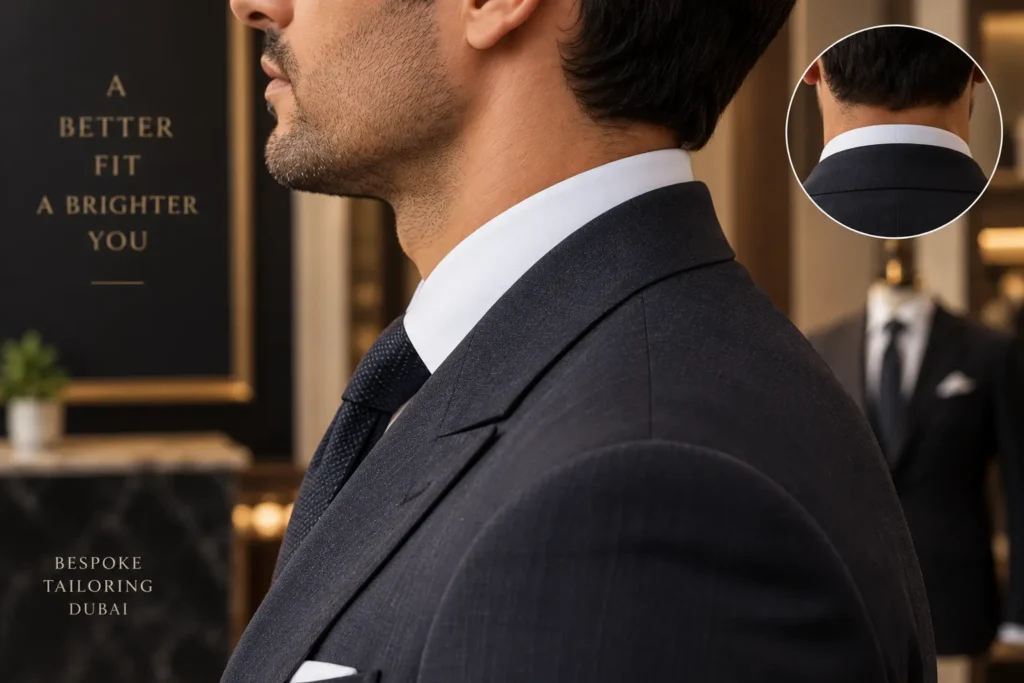
Collar gap is exactly what it sounds like — a visible space between the back of your jacket collar and your shirt collar when you’re standing normally. Instead of the jacket hugging the base of your neck, it lifts away, sometimes just slightly, sometimes enough to see a strip of shirt collar (or worse, bare shoulder) poking through behind your neck.
It’s one of those things that’s hard to unsee once you notice it, especially in photos taken from the side or back — which, unfortunately, describes most wedding photography and headshots.
The causes are rarely about the collar itself. More often, it comes down to:
- Shoulder fit — if the jacket’s shoulder is too wide, or the slope of the shoulder seam doesn’t match your own shoulder angle, the whole jacket sits slightly wrong and the collar gets pulled out of place.
- Posture — this is a big one, and it’s especially common with men who spend long hours at a desk. A forward head position or a slightly rounded upper back means the jacket, cut for someone standing perfectly upright, simply can’t lie flat against the neck.
- Back balance — if the length of the jacket’s back doesn’t match your torso proportions, you’ll often see the collar lift as a direct result.
- Construction quality — cheaper jackets use stiffer interlining and less refined collar construction, which makes it harder for the collar to curve naturally around the neck no matter how good the rest of the fit is.
Can a Tailor Fix Collar Gap? When Alterations Work and When They Don't
This is genuinely one of the most common questions we get, and the honest answer is: it depends on how much of a gap you’re dealing with, and where it’s coming from.
A small gap can often be corrected by a skilled tailor reshaping the collar stand, adjusting the shoulder pitch slightly, or trimming excess fabric from the back to remove the lift. This kind of work requires real hand skill, but it’s a legitimate alteration and it can make a meaningful difference.
Where it gets harder is with larger gaps — the kind you’d describe as visible from across a room rather than something only you’d notice. At that point, the problem usually isn’t the collar at all. It’s a structural mismatch between the jacket’s pattern and your body or posture, and no amount of reshaping the collar seam is going to correct something that was wrong from the shoulder down. Trying to force a fix in these cases often costs more in tailoring fees than it’s worth, and the result still won’t be quite right.
If you’re dealing with a gap that keeps returning no matter what’s been altered, it’s usually a sign that the garment needs to be built around your actual shape from the start — which is often when a bespoke suit becomes a more practical solution than repeatedly altering a garment that was not originally drafted for your proportions.
What Are Dropped Shoulders and How Do They Affect Fit?
Dropped shoulders happen when the jacket’s shoulder seam sits past your natural shoulder point out toward your arm rather than ending where your shoulder actually stops. The result is a soft, sloped look that reads as oversized even if the rest of the jacket technically fits.
It’s usually easy to spot once you know what you’re looking for: the seam visibly overhangs the edge of the shoulder, there’s often a small dent or crease at the sleeve head, and it tends to come paired with the collar gap issue we just covered, since both problems often share the same root cause.
Dropped shoulders are often the result of a sizing compromise. Men with a broader chest or torso frequently size up to accommodate it, which drags the shoulder seam along with everything else — even though their actual shoulder width didn’t need the extra room. It’s also one of the areas where alterations genuinely hit a wall. The shoulder is arguably the single hardest part of a jacket to correct after the fact, because it’s tied into the entire structural framework of the garment the canvas, the padding, the way the sleeve is set. Moving it means rebuilding, not adjusting.
The Athletic Build Challenge: Why Ready-to-Wear Suits Fail
If you train regularly, you’ve probably lived through this exact scenario: you find a jacket that closes comfortably over your chest and shoulders, only to find noticeably loose fabric around the waist.Or you go the other way — buy for the waist — and the jacket won’t close properly across your chest at all.
This happens because most off-the-rack suits are drafted around a fairly modest difference between chest and waist measurement. An athletic, V-shaped build — broader shoulders, a fuller chest, a noticeably narrower waist — often exceeds that difference by a significant margin. There’s no ready-made size that solves this, because the problem isn’t your size, it’s your proportion.
The knock-on effects show up everywhere: sleeves that grip the biceps too tightly, a waist that can’t be suppressed enough to avoid looking boxy, trousers that strain across the thigh while gapping at the back of the waistband. Taking in a jacket waist by several inches to compensate distorts the pockets, the side seams, and the overall balance of the garment it can improve the appearance, but it may not fully resolve the underlying fit problem.
How Bespoke Tailoring Solves Fit Problems for Athletic Builds
This is where building a pattern from scratch, rather than adjusting an existing one, actually earns its reputation. A few of the specific things a tailor accounts for:
Shoulder width and slope are measured directly from your body, so the seam lands exactly where your shoulder ends — no overhang, no pulling.
Chest room is built in at the pattern stage, drafted around your actual chest measurement so there’s no strain across the button line and no bunching under the arms.
Waist suppression is shaped into the side seams from the beginning, rather than being carved out of an existing garment afterward. This is really the difference-maker for athletic builds — the taper follows your natural shape instead of fighting against a boxier starting point.
Sleeve and armhole fit account for larger arm circumference and a higher, tighter armhole, which — somewhat counterintuitively — actually gives you more freedom of movement, not less, because the sleeve isn’t dragging against the body when you reach or turn.
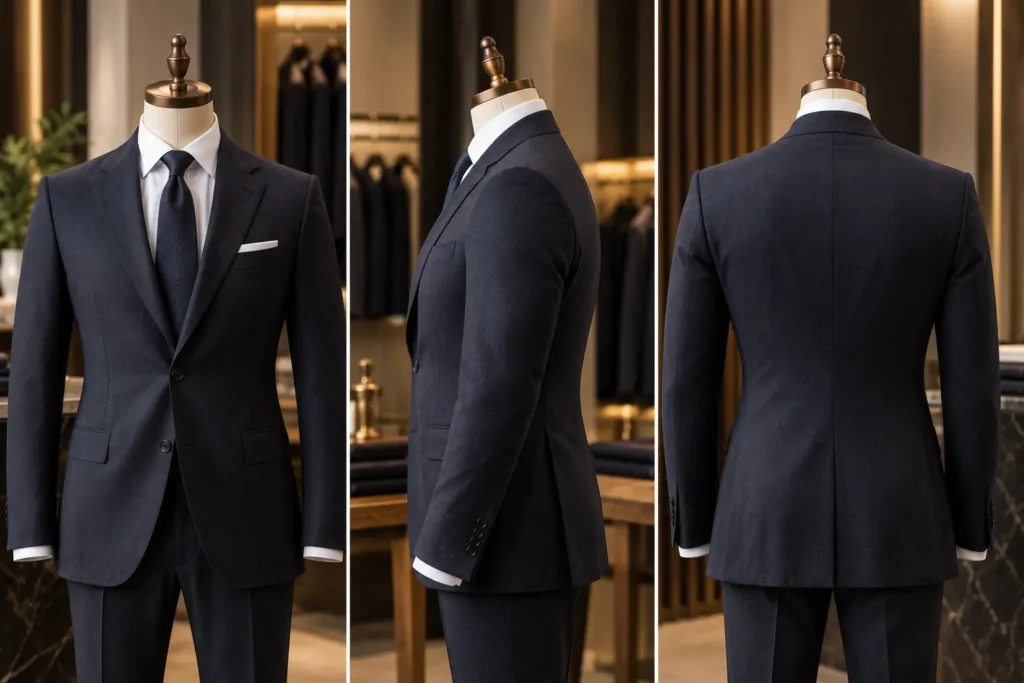
None of this is guesswork. It comes from a proper measuring and fitting process, which we’ll get into shortly — and it’s the foundation of what a [Custom Suit Measurements] consultation at TWS is actually built around.
The Role of Measurements and Pattern Adjustments in Fit Correction
A good pattern isn’t drawn from two or three numbers. It’s built from a fuller picture of your body: shoulder width and slope, chest and waist circumference, back length, neck size, the width across your back near the shoulder blades, sleeve pitch (the angle at which the sleeve is set into the armhole), and several others besides.
What makes this different from simply “taking measurements” is that a tailor is also reading your posture while doing it — noting whether you carry your head forward, whether your back rounds slightly, whether one shoulder sits a touch higher than the other, as most people’s do. Those observations get built into the pattern itself, not corrected afterward with pins and patches. That’s really the core difference between bespoke tailoring and altering something off the rack: the fit is designed in from the start, rather than chased down after the fact.
Which Suit Problems Can Be Altered and Which Require Bespoke?
It helps to think of this as two categories.
Usually fixable with alteration: a waist that needs taking in modestly, sleeves that need shortening, trousers that need hemming, a minor collar gap, small adjustments to a waistband.
Usually not fixable without a new pattern: dropped shoulders, a pronounced collar gap rooted in posture rather than a loose collar seam, the kind of chest-to-waist difference typical of an athletic build, a jacket that’s simply too tight through the chest or shoulders with no fabric left to let out, or a sleeve set at the wrong pitch.
A rough rule worth knowing: if the alterations needed start piling up — three or four separate structural changes — or if the cost of getting there approaches what a new, properly fitted garment would cost, it’s worth stepping back and asking whether alteration is really the efficient path. Our [Alterations] service is well suited to the first category; for the second, a bespoke build tends to be the more sensible route.
Common Suit-Fitting Problems Men Experience
Beyond the three main issues covered above, a few other complaints come up often enough to mention: chest fabric pulling when the jacket is buttoned, excess fabric bunching at the waist with no real shape to it, sleeves that seem to twist slightly when your arms are at rest, a jacket that rides up at the back, or vents that flare open when you’re simply standing still. On the trouser side — tightness across the thigh, a seat that pulls, or a waistband that gaps at the back — are all signs the trouser was cut for a different proportion than yours.
Most of these trace back to the same handful of root causes we’ve already covered: shoulder fit, posture, and proportion. It’s rarely one isolated problem
Inside a Professional Bespoke Fitting Process
It usually starts with a proper consultation — taking a wide set of measurements, discussing fabric and style, and, just as importantly, observing how you actually stand and move.
From there comes a baste fitting: a partially constructed jacket, stitched loosely enough that a tailor can see exactly how the shoulders sit, where the balance falls, and whether any drag lines are showing up that point to a deeper fit issue. This stage is where most of the real correction happens, before a single seam is finished permanently.
A second fitting follows in the actual fabric, refining details like sleeve length and waist shaping. The final fitting is largely about the small things — a touch here, a slight adjustment there — before the finished garment is handed over. It’s a slower process than buying off the rack, admittedly, but it’s also the reason the end result tends to hold its shape properly.
UAE Specific Tailoring Considerations
Dubai and Abu Dhabi brings their own set of practical demands into this conversation. The heat means fabric choice matters as much as cut — lightweight tropical wools, linens, and breathable blends tend to serve better here than heavier cloths that were designed for cooler climates. Our [Fabric Guide] covers this in more depth if you’re weighing options.
The city’s business culture, particularly around DIFC and similar hubs, still leans toward sharply fitted, conventional tailoring for client-facing work — For client-facing work, a clean and well-balanced fit can make a strong impression, regardless of the label inside the jacket.
Weddings are their own category entirely. Grooms are increasingly choosing bespoke for the simple reason that wedding photography is unforgiving of any fit issue, and a collar gap or dropped shoulder that you’d normally shrug off becomes permanent the moment it’s printed. If that’s where you’re headed, our [Wedding & Formalwear] service is worth a look early rather than a few weeks out.
And Dubai’s fitness culture plays a real role too — a large share of the athletic-build fitting challenges we see come from men who train seriously and have simply never found a ready-made suit that reflects that.
Frequently Asked Questions
What causes collar gap in a suit jacket?
Most often it’s a mismatch between the jacket’s shoulder or back pattern and your own shoulder slope or posture not the collar itself.
Can a tailor fix dropped shoulders?
Minor cases sometimes respond to alteration, but because the shoulder is structural to the whole jacket, larger corrections usually require the garment to be rebuilt around a proper shoulder measurement.
Why don't suits fit athletic builds off the rack?
Ready-to-wear patterns are drafted around a modest chest-to-waist difference. A V-shaped build often exceeds that by enough that no single size works well in both places.
How many measurements does a bespoke tailor take?
It varies by tailor and garment, but a thorough bespoke suit measurement involves a detailed set of measurements across the body, along with observations about posture, shoulder balance, and proportions.
What is sleeve pitch, and why does it matter?
It’s the angle at which the sleeve is set into the armhole. Get it wrong and sleeves twist or wrinkle even when the rest of the jacket fits well.
How does posture affect suit fit?
Significantly. A forward head position or rounded back changes how a jacket needs to be cut through the collar and back — a garment made for perfect upright posture won’t sit right on someone who doesn’t stand that way, which is most people.
When should I choose bespoke over alterations?
When the issue is structural shoulders, posture-driven collar gap, or a proportion mismatch like an athletic build rather than something minor like length or a small waist adjustment.
Final Thoughts
Fit problems like these aren’t really about bad luck with sizing. They’re the predictable result of a garment built for an average body meeting a body that isn’t average which, in practice, describes almost everyone. A skilled tailor can solve some of this through alteration. The rest genuinely needs to be drafted from the start with your specific shoulders, posture, and proportions in mind.
If you’ve been living with a suit that never quite sits right, it’s worth having someone look at the actual cause rather than continuing to alter around it. [Book a consultation] with TWS and we’ll walk through what’s really going on and what it would take to fix it properly.

Asif
I’m Asif, a men’s tailoring and bespoke specialist at The White Stripes Tailors and Shirtmakers with 15+ years of hands on experience in creating custom clothing and bespoke suits. I focus on delivering perfect fit, comfort, and modern style for every client that works for the UAE weather and beyond.
I work closely with clients to understand their preferences and guide them in selecting the right fabrics, designs, and fittings for both formal and casual wear. My approach combines traditional tailoring techniques with current fashion trends to ensure high-quality results.
Through The White stripes, I also share practical insights on suit fabrics, styling tips, and tailoring guidance to help customers make confident choices.
All Posts
Written By:
Recent blog posts
How Bespoke Tailoring Fixes Collar Gap, Dropped Shoulders, and Athletic Builds
Asif
September 21, 2026
Read More »
Side Adjusters vs. Belt Loops: The Sartorial Guide to Men’s Custom Trousers in the UAE
Asif
September 21, 2026
Read More »